
What Happens After Your New AC System Is Installed (And Why It Matters)
What happens after your new AC system is installed is just as important as the installation itself. Many homeowners assume the job is done once the technician drives away and cold air starts flowing — but that moment is actually the beginning of a critical setup period that determines how well your system performs for the next 10 to 15 years.
Here is a quick overview of what should happen right after installation:
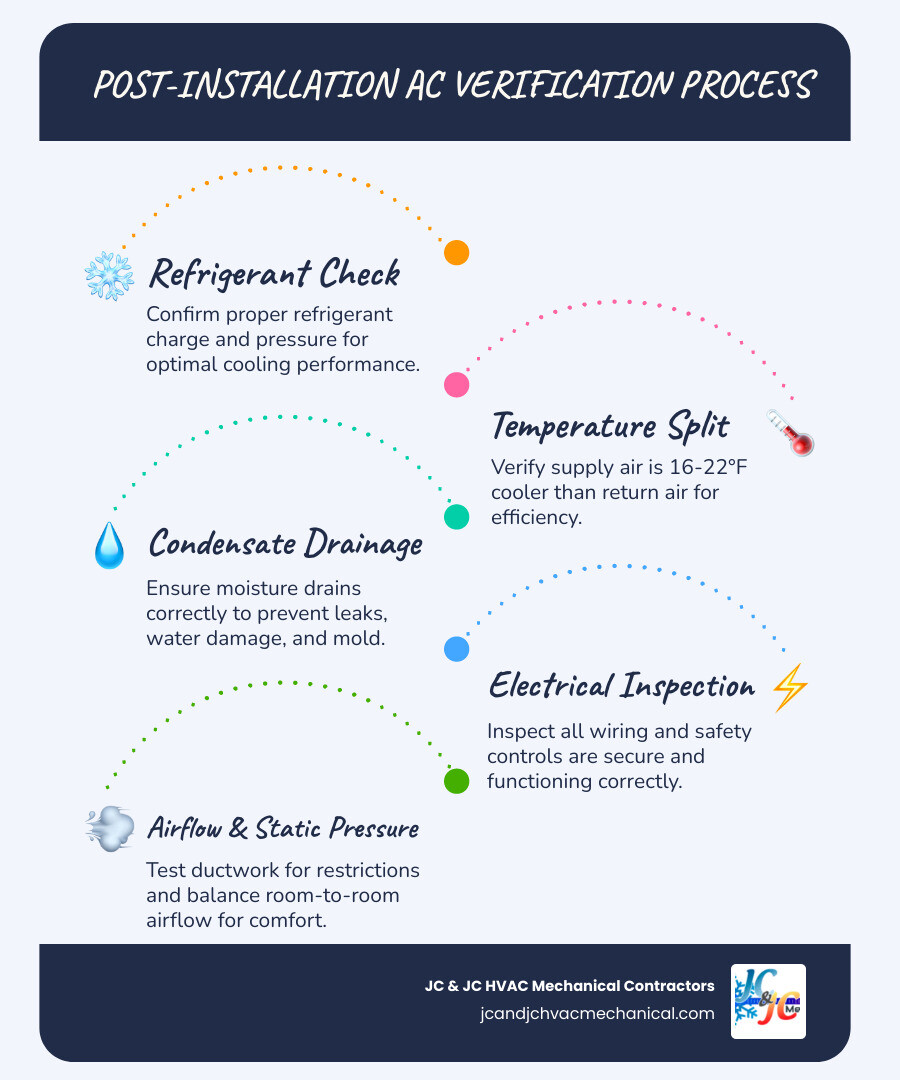
- Refrigerant charge and pressure verification — technicians confirm the system is properly charged
- Temperature split check — supply air should be 16–22°F cooler than return air
- Condensate drainage test — ensures moisture drains correctly and won’t cause leaks or mold
- Electrical connection inspection — all wiring and safety controls are confirmed secure
- Thermostat calibration — settings are matched to your home’s actual temperature readings
- Airflow and static pressure testing — ductwork is checked for restrictions and room balance
- Warranty registration — documentation is filed within 30–60 days to protect your investment
Skipping any of these steps can lead to higher energy bills, uneven cooling, and repairs that could have been avoided early on. For homeowners in the MD/DC suburbs — where summer heat and humidity put serious demand on cooling systems — getting these checks right from day one is not optional, it is essential.
Immediate Post-Installation Checks and Testing
Once the physical units are in place, we enter the “commissioning” phase. This is where we transition from having a piece of machinery to having a high-performance cooling system. Professional Air Conditioning Services/Ac Installation aren’t complete until several technical benchmarks are met.
First, we perform a refrigerant charge and pressure verification. If a system is even slightly undercharged, it will struggle to cool on a humid July afternoon in Bethesda. Overcharging is just as bad, as it puts unnecessary strain on the compressor. We also look for the temperature split. This is the difference between the air going into your return vents and the air coming out of your supply registers. Ideally, you want to see a drop of 16 to 22 degrees. If it’s less than that, the system isn’t removing enough heat.
Another critical check is the condensate drainage. Your AC doesn’t just cool the air; it dehumidifies it. In Maryland and D.C., that means gallons of water are being pulled out of your indoor air every day. We test the primary and secondary drain lines to ensure that water flows outside or into a floor drain—not into your ceiling or onto your basement floor. Finally, we verify the electrical connections and the startup sequence. We want to ensure that the “inrush current” (the power spike when the system starts) is within safe limits for your home’s electrical panel.
What Happens After Your New AC System is Installed: The First 30 Days
The first month is what we call the “settling-in period.” Even the best-installed systems need a little time to adjust to your home’s specific environment. During this time, the building materials in your home—the wood, drywall, and furniture—will gradually reach a new equilibrium as the system manages humidity more effectively.
If you’ve upgraded to a high SEER2 efficiency model, you’ll likely notice that the air feels different. Modern systems are designed to run longer cycles at lower speeds, which is much better for removing Maryland’s thick humidity. This is a great time to start thinking about Air Conditioning Services/Ac Maintenance to keep that high efficiency from dipping.
Monitoring Performance: What Happens After Your New AC System is Installed
During the first few weeks, pay close attention to your cooling speed and cycle length. If your home is 80 degrees and you set it to 72, it shouldn’t take all day to get there, but it shouldn’t take five minutes either. If the system turns on and off every few minutes (known as short cycling), it might be oversized or have a calibration issue.
You are also looking for indoor comfort consistency. Are there “hot spots” in the kitchen while the living room is like an icebox? While some of this relates to your home’s layout, it can often be fixed with minor adjustments. Understanding What Is A Good Seer Rating For My New Ac will help you set realistic expectations for your energy bills during this first month.
Recognizing Early Red Flags
While we aim for perfection, sometimes the “real world” reveals minor issues that didn’t show up during the initial test. Keep an ear out for unusual noises. A gentle hum is normal; a high-pitched squeal, banging, or persistent rattling is not. Burning odors are common for the first 20 minutes of a new furnace or heat pump (as factory coatings burn off), but if an acrid, electrical smell persists after a few hours of AC use, shut it down and call us.
Short cycling and water leaks are the most urgent red flags. If you see water pooling around the indoor unit, it usually means a drain line is blocked or the pan isn’t level. Understanding What Is Included In Hvac Maintenance And Why Its Important can help you spot these issues before they cause property damage.
Optimizing Comfort Through Airflow Balancing and Calibration
What happens after your new AC system is installed often involves a bit of “fine-tuning.” This is where airflow balancing comes in. Your ductwork was likely designed years ago for a different system. We use static pressure testing to measure the resistance your fan is fighting against. If the pressure is too high, your system will be noisy and inefficient.
We may need to adjust dampers in your ducts to ensure that the upstairs bedrooms—which are notoriously hard to cool in Rockville or Potomac—get a bit more “push” than the basement. This room-to-room balance is the difference between a system that works and a system that makes you comfortable. How To Choose The Right Size Hvac Unit For Your Home is only half the battle; the other half is making sure the air actually reaches you.
Thermostat Calibration: What Happens After Your New AC System is Installed
Your thermostat is the “brain” of the operation. If it’s not calibrated correctly, it might think the house is 72 degrees when it’s actually 75. We check temperature accuracy by comparing your thermostat’s reading to a calibrated professional thermometer.
If you’ve opted for a smart thermostat, we ensure it is communicating correctly with the outdoor unit. Sensor placement is also vital. If your thermostat is right next to a sunny window or a kitchen oven, it will give false readings. This is a key part of our Air Conditioning Services/Ac Installation Replacement Bethesda Md process, ensuring your controls are as precise as the equipment itself.
Essential Documentation and Long-Term Maintenance Habits
Once the technicians leave, the paperwork begins. You should have a folder containing your model numbers, serial numbers, and installer contact information. The most important task for you is warranty registration. Most manufacturers require you to register your new unit within 60 days to unlock the full 10-year parts warranty. If you forget, it might default to only 5 years.
We highly recommend looking into a Maintenance Agreement. This ensures that your system gets the professional attention it needs to stay within warranty guidelines and maintain its efficiency.
Basic Maintenance Tasks to Start Right Away
You don’t have to be an expert to help your system. The simplest and most effective task is staying on top of filter changes. In the D.C. area, pollen and dust can clog a filter faster than you’d think. Check your filter every 30 days. If it looks gray or furry, replace it.
Also, keep an eye on your outdoor unit clearance. Ensure there is at least two feet of clear space around the condenser. Trim back any shrubs, and remove debris like grass clippings or fallen leaves. This ensures the unit can “breathe” and dump the heat from your home effectively. Regular Air Conditioning Services/Ac Maintenance will handle the deep cleaning, but these small habits make a huge difference.
Frequently Asked Questions about New AC Systems
How long does it take for a new AC to cool the house?
This is known as the “pull-down” period. If your home was 85 degrees when the system was turned on, it could take several hours—sometimes up to 24—to remove the heat stored in your walls, furniture, and floors. Once that initial heat is gone, the system should maintain your target temperature easily.
Why is my new AC making a weird smell?
A slight “dusty” or “metallic” smell is normal for the first hour or two as factory coatings on the coils are exposed to airflow for the first time. However, if you smell something like dirty socks (mold) or a sharp electrical burning scent, it’s worth a call to check the condensate drainage or wiring.
When should I schedule my first professional tune-up?
We recommend a 30-day check or at least a follow-up at the start of the next season. This allows us to perform seasonal optimization, checking that the refrigerant pressures are still correct after the system has “broken in.” You can learn more about What Is Included In Hvac Maintenance And Why Its Important to see why this first visit is so valuable.
Conclusion
At JC & JC HVAC Mechanical Contractors, we believe that a great installation is just the start of our relationship with you. What happens after your new AC system is installed—from the professional commissioning to the first month of monitoring—is what ensures your home remains a sanctuary from the Mid-Atlantic heat.
Whether you are in Bethesda, Silver Spring, or right in the heart of Washington D.C., our team is dedicated to providing the expert, professional service that has earned us over 270 excellent reviews. Don’t leave your comfort to chance. If you’ve just had a system installed or are ready for an upgrade, trust us to handle the details. Ready to ensure your home stays cool for years to come? Explore our Air Conditioning Services/Ac Installation and let’s get your system optimized today.