
Why Understanding How a Tune Up Improves Efficiency and Lowers Bills Matters for DC Metro Homeowners
How a tune up improves efficiency and lowers bills comes down to one core idea: a clean, well-adjusted system uses less energy to do the same job.
Here is a quick breakdown of how it works:
- Dirty coils and clogged filters force your AC to run longer and work harder, burning more electricity
- Low refrigerant or worn components reduce cooling output, causing the system to cycle more often
- Lubricated motors and tight electrical connections reduce friction and power draw
- Calibrated thermostats prevent unnecessary run cycles that waste energy
- Clean blower wheels and clear drain lines restore proper airflow so your home reaches the set temperature faster
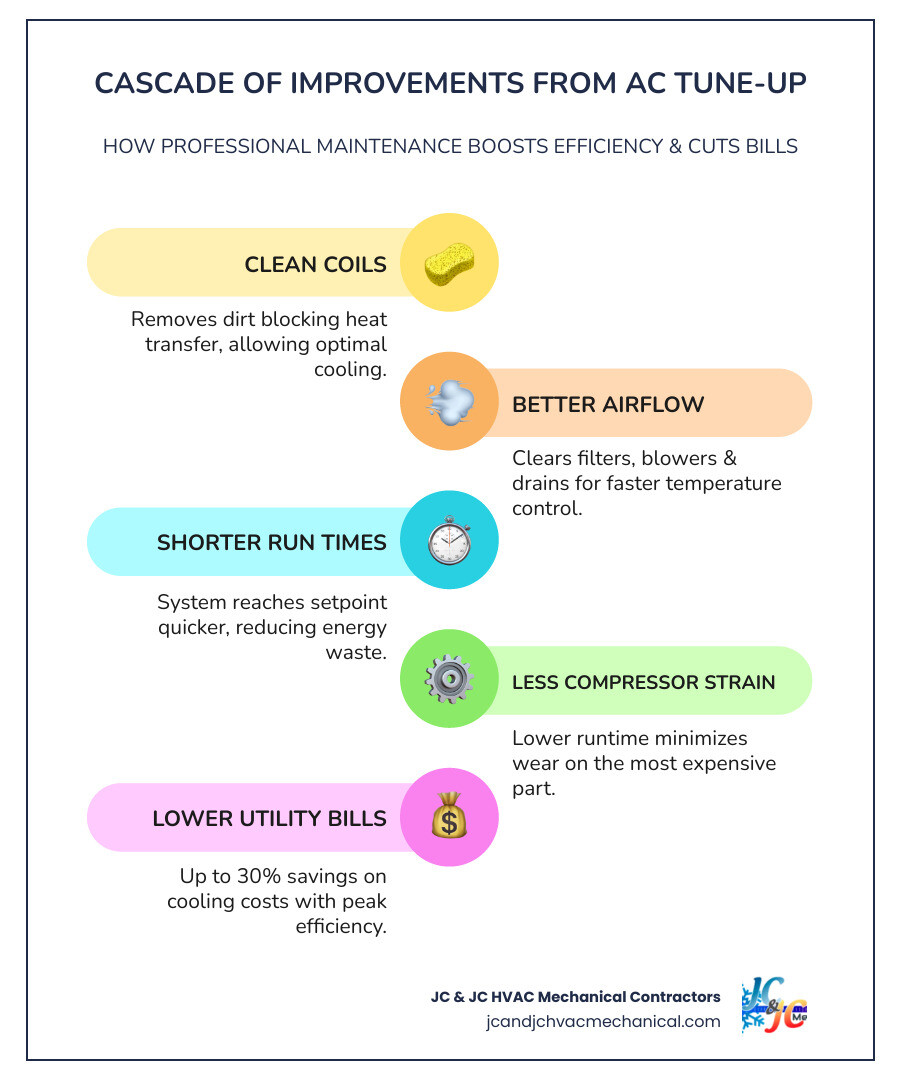
Together, these small fixes create a cascade effect — better heat transfer leads to shorter run times, which reduces wear on the compressor and lowers your monthly utility bill. Well-maintained systems can save homeowners up to 30% on heating and cooling costs compared to neglected equipment.
For homeowners in the MD/DC suburbs, this is not a small detail. Washington, DC summers arrive fast, humidity climbs early, and an AC unit that spent the winter sitting idle is rarely ready to perform at full capacity when you first flip it on in May. If the system is already losing efficiency from dust buildup, a weak capacitor, or a dirty coil, you will feel it in your comfort — and see it on your energy bill — before you ever notice anything is wrong.
Skipping annual maintenance is one of the most common and costly mistakes homeowners make. Not only does it chip away at efficiency month after month, it can also void your manufacturer’s warranty and turn a minor issue into an emergency repair in the middle of a July heat wave.
Understanding How a Tune Up Improves Efficiency and Lowers Bills
When we talk about how a tune up improves efficiency and lowers bills, we are looking at the physics of your HVAC system. Your air conditioner doesn’t actually “create” cold; it removes heat from your indoor air and dumps it outside. Anything that stands in the way of that heat transfer process makes the system work overtime.
Imagine trying to run a marathon while breathing through a cocktail straw. That is exactly what your AC feels like when it has a clogged filter or a layer of Potomac-area pollen coating the outdoor condenser coils. By cleaning these components, we restore the system’s ability to breathe.
Efficiency and SEER Ratings
Modern systems are assigned a SEER (Seasonal Energy Efficiency Ratio) rating. This number represents the “optimal” efficiency of the unit. However, that rating is based on factory-clean conditions. As dust accumulates and parts wear down, your “SEER 16” unit might start performing like a “SEER 12.” A professional tune-up is designed to restore that factory-level performance. According to our DC Metro Homeowners Guide to Better AC Performance, maintaining these ratings is the most effective way to keep your cooling costs predictable.

The Role of Airflow and Friction
Airflow optimization is a major part of how a tune up improves efficiency and lowers bills. When the blower motor has to fight against dirt on the blades or friction in the bearings, it draws more amperage. More amperage equals more money out of your pocket. By lubricating motors and cleaning the blower assembly, we reduce the electrical draw significantly. Furthermore, a clean system reaches your desired temperature faster, meaning the compressor (the most expensive and power-hungry part of your AC) can shut off sooner.
Efficiency-Draining Culprits
Several silent “thieves” could be stealing efficiency from your home right now:
- Fouled Coils: Can increase compressor runtime by up to 15%.
- Incorrect Refrigerant Levels: Even being slightly “off” can increase energy use by 5% to 15%.
- Loose Wiring: Causes voltage drops and forces components to run hotter and less efficiently.
- Dirty Flame Sensors (for Heating): Causes short-cycling, which wastes fuel and electricity.
How a tune up improves efficiency and lowers bills by restoring factory specs
Your HVAC system is a complex network of electrical and mechanical components that must work in perfect synchronization. Over time, that synchronization drifts.
During a precision visit, we focus on thermostat calibration. If your thermostat is off by just two degrees, your system may run for an extra 30 to 45 minutes every day. We also perform voltage and amperage testing on all motors. This allows us to see if a part is working harder than it should be, which is a key indicator of impending failure or energy waste.
By tightening electrical connections and testing safety controls, we ensure the system operates exactly as the manufacturer intended. For a deeper look at these technical steps, see our guide on What is Included in HVAC Maintenance and Why It’s Important. It’s about more than just a visual check; it’s about restoring the technical balance of the machine.
How a tune up improves efficiency and lowers bills for aging systems
If your system is more than 10 years old, maintenance isn’t just a “good idea”—it’s a survival tactic. Aging systems naturally lose efficiency as mechanical parts wear down. However, regular care can significantly slow this decline.
In areas like Silver Spring and Bethesda, humidity control is just as important as temperature. An aging, unmaintained AC struggles to remove moisture from the air. When humidity is high, you feel warmer, which often leads to homeowners “cranking down” the thermostat even further. This creates a cycle of high bills and unnecessary mechanical stress.
Our specialized AC Maintenance & Tune-Up Silver Spring, MD services focus on heat transfer optimization for older units, ensuring they can still handle a DC heat wave without breaking the bank.
The Professional Maintenance Checklist: What Happens During a Visit?
A professional tune-up is a multi-point inspection that typically takes 60 to 90 minutes. It is a comprehensive “physical” for your home’s hardest-working appliance.
The Cooling Checklist
When we perform AC Maintenance, we go through a rigorous process:
- Condenser Coil Cleaning: We remove the dirt, grass clippings, and debris that act as an “insulating blanket” on your outdoor unit.
- Refrigerant Charge Verification: We check for leaks and ensure the “coolant” is at the precise level for maximum heat absorption.
- Blower Assembly Cleaning: This ensures the air moving through your vents is clean and moving at the correct velocity.
- Condensate Drain Clearing: We prevent water damage and mold growth by ensuring the moisture your AC pulls from the air has a clear path out of your home.
- Capacitor Testing: We test the “batteries” that help your motors start. Replacing a weak capacitor now prevents a total system shutdown later.
The Heating Checklist
While we often think of tune-ups in the spring, Heater Maintenance is equally critical for winter safety and efficiency. This includes:
- Heat Exchanger Inspection: We check for tiny cracks that could leak carbon monoxide into your home.
- Burner Cleaning: Ensuring a clean, blue flame for maximum fuel efficiency.
- Flame Sensor Testing: Preventing the system from “short-cycling” and wasting energy.
- Safety Limit Checks: Verifying that all safety switches are operational to prevent overheating or fire hazards.
Why Preventative Maintenance Beats Reactive Repair Every Time
Most homeowners only call an HVAC company when the air stops blowing. This is called “reactive repair,” and it is almost always the most expensive way to manage your home.
| Feature | Preventative Maintenance | Reactive Repair |
|---|---|---|
| Scheduling | At your convenience | During an emergency |
| Cost | Low, predictable investment | High, unexpected repair bills |
| Efficiency | Restored to peak levels | System struggles until it fails |
| Lifespan | Extends equipment life | Shortens equipment life |
| Reliability | High peace of mind | High risk of mid-season failure |
By identifying a worn belt or a failing sensor during a scheduled visit, we can replace the part before it causes a “cascade failure” that destroys more expensive components like the compressor or blower motor. As we discuss in our article on Ways to Save on HVAC Costs This Spring, catching these issues early is the single best way to avoid “venting your cash” on emergency service calls.
Furthermore, being a proactive homeowner allows you to Stop Venting Your Cash with HVAC Service Agreements. These agreements often provide priority service, ensuring that if something does go wrong during a holiday weekend, you aren’t stuck at the bottom of a long waiting list.
Long-Term Financial and Safety Benefits of Regular Service
The benefits of how a tune up improves efficiency and lowers bills extend far beyond the next month’s utility statement.
Extending System Lifespan
A typical HVAC system is designed to last 15 to 20 years, but without maintenance, many fail closer to the 10-year mark. Think of it like a car: if you never change the oil, the engine will eventually seize. Your AC’s compressor is its “engine.” Regular lubrication and cleaning reduce the friction that leads to burnout. To learn more about maximizing your investment, check out How Long Do Air Conditioners Last and How Can AC Tune-Ups Help?.
Warranty Protection
This is a “hidden” benefit that many homeowners miss. Almost every major HVAC manufacturer (like Bryant, Carrier, or Lennox) requires proof of annual professional maintenance to honor the equipment warranty. If your compressor fails in year five, but you have no record of annual service, the manufacturer may deny your claim, leaving you responsible for the full cost of the part.
Safety and Indoor Air Quality
Safety is our top priority. During a heating tune-up, we perform carbon monoxide detection tests to ensure your family is safe from this “silent killer.” Additionally, cleaning the internal components of your HVAC system reduces the amount of dust, pollen, and microbial growth that gets circulated through your home, significantly improving indoor air quality.
Environmental Impact
Keeping your system well-tuned is also an act of environmental stewardship. A more efficient system consumes less electricity and fuel, which reduces the overall carbon footprint of your household. By lowering the demand on the local power grid during peak DC summers, you are contributing to a more resilient and sustainable community.
Frequently Asked Questions about HVAC Tune-Ups
How often should I schedule a tune-up to maintain peak performance?
We recommend bi-annual scheduling for the best results. You should schedule a cooling check in the spring (March through May) and a heating check in the fall (September through November). This ensures your system is ready for the extreme temperature shifts we see in the DC Metro area. Enrolling in a Maintenance Agreement is the easiest way to stay on schedule without having to remember to call us every six months.
What are the primary signs that my system is losing efficiency?
If you notice any of the following, it’s time to call us:
- Rising utility bills: If your energy costs are higher than they were the same month last year, your efficiency is likely dropping.
- Frequent cycling: The system turns on and off every few minutes.
- Unusual noises: Banging, squealing, or rattling often indicate loose or worn parts.
- Weak airflow: You can feel air coming out of the vents, but it doesn’t seem to be “pushing” as hard as it used to.
- Inconsistent temperatures: Some rooms are freezing while others are stifling.
Can a homeowner perform a tune-up themselves?
While we love a proactive homeowner, a full tune-up requires specialized tools and training. You can (and should!) change your air filters every 1 to 3 months and keep the area around your outdoor unit clear of leaves and debris. However, tasks like testing refrigerant levels, handling high-voltage electrical components, and inspecting heat exchangers for microscopic cracks require professional expertise. Attempting these yourself can be dangerous and will often void your warranty.
Conclusion
At JC & JC HVAC Mechanical Contractors, we pride ourselves on providing expert, professional service to our neighbors in Washington, D.C., Montgomery County, and Howard County. With over 270 excellent reviews, our team understands the unique demands the Mid-Atlantic climate places on your home.
Understanding how a tune up improves efficiency and lowers bills is the first step toward a more comfortable, affordable home. Don’t wait for the first 90-degree day to find out your AC isn’t up to the task. Whether you are in Rockville, Bethesda, or Silver Spring, we are here to provide the precision care your system deserves.
Schedule your AC Maintenance & Tune-Up in Washington, DC today and experience the peace of mind that comes with a professionally maintained home.