
Why Regular AC Maintenance Is the Single Biggest Factor in System Longevity
How AC maintenance extends your system lifespan comes down to one core idea: a system that runs clean, balanced, and inspected regularly experiences far less mechanical stress — and lasts significantly longer as a result.
Here is a quick summary:
- Reduces component wear — Clean coils, clear filters, and lubricated moving parts mean every component works within its designed limits
- Catches small problems early — A loose wire or minor refrigerant leak found during a tune-up costs far less than a failed compressor
- Maintains efficiency — A system that doesn’t have to work overtime runs shorter cycles, which means less wear over time
- Protects the compressor — The most expensive part in your system is also the most vulnerable to neglected coils and low refrigerant
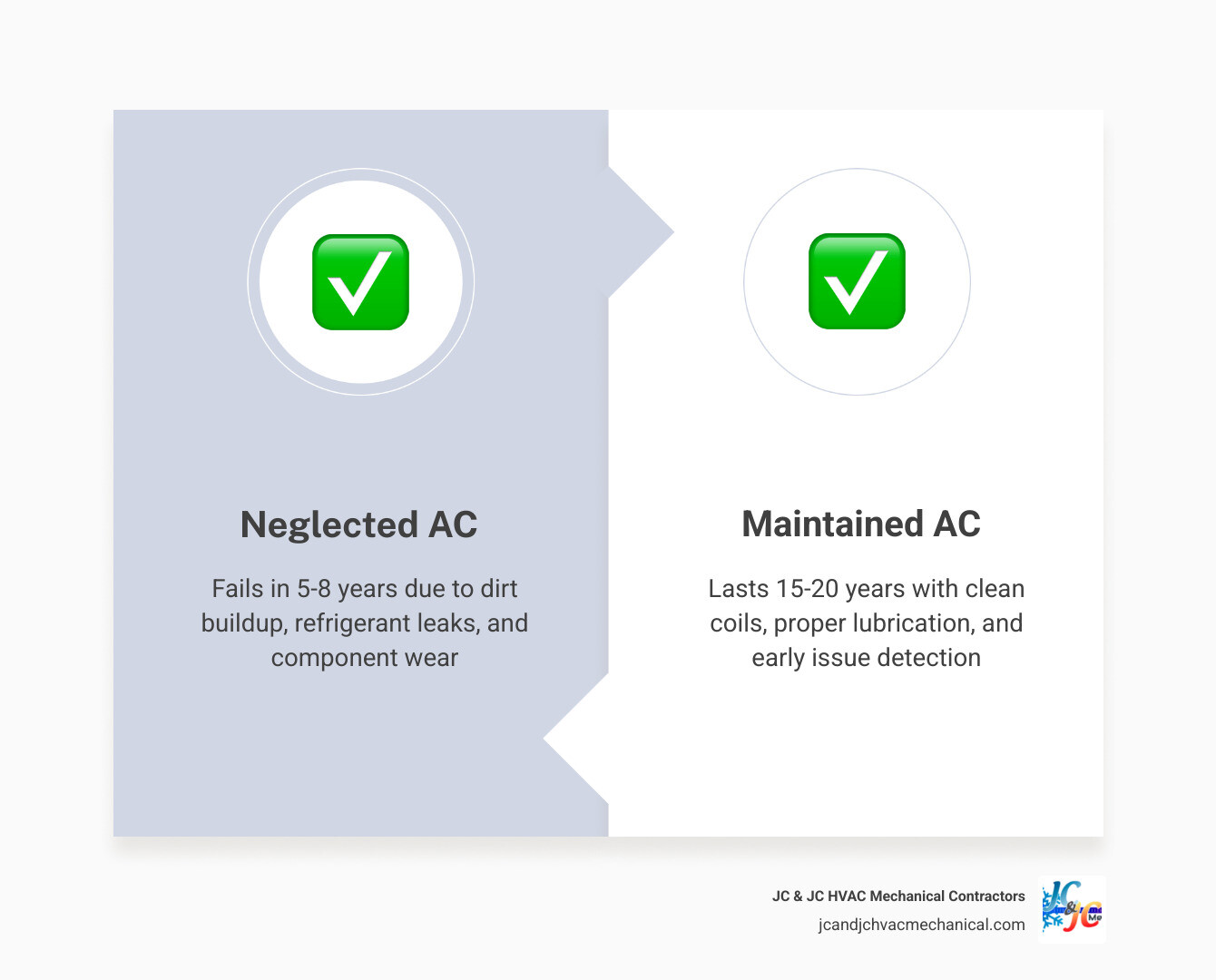
- Extends lifespan by years — Well-maintained AC units commonly reach 15 years or more; neglected ones often fail before year 8
If your AC is running in the Maryland or Washington D.C. area, this gap matters even more. Humid summers push systems harder and longer than in drier climates, making routine care less optional and more essential.
The difference between a system that lasts 8 years and one that lasts 15 or even 20 years is rarely about the brand or the price tag. It almost always comes down to how consistently that system was maintained.
The Numbers: How AC Maintenance Extends Your System Lifespan
When we talk about the lifespan of an air conditioner in May 2026, we are looking at a piece of machinery that is more efficient than ever but also more complex. This complexity makes maintenance even more critical. Statistics show a stark divide between systems that receive professional attention and those that are left to fend for themselves.
Typically, a central air conditioning unit is designed to last between 12 and 15 years. However, this “average” is a bit misleading. In our experience serving homes from Bethesda to Silver Spring, we see two very different stories. A neglected unit—one that has gone years without a professional cleaning or inspection—often begins to suffer catastrophic component failure around the 5 to 7-year mark. On the flip side, a well-maintained system can easily cruise past 15 years, with some reaching a 20-year potential.
| System Type | Average Lifespan (Neglected) | Average Lifespan (Maintained) |
|---|---|---|
| Central Air Conditioner | 5–8 Years | 12–15+ Years |
| Heat Pump | 5–7 Years | 10–15 Years |
| Furnace | 10–12 Years | 15–25 Years |
Why is there such a massive gap? It’s all about mechanical wear. Imagine driving your car for 50,000 miles without an oil change. The engine wouldn’t just stop; it would slowly degrade, with parts grinding against each other until the whole thing seized. Your AC is no different. Without routine care, the system works harder to achieve the same cooling effect. This extra effort leads to component degradation, specifically in the motor and compressor, which are the “heart” of your home’s comfort.
If you are curious about the specifics of these timelines, you can read more about How Long Do Air Conditioners Last and How Can AC Tune-Ups Help? to see how professional intervention changes the math for your home.
Anatomy of a Tune-Up: Protecting Critical Components
A professional tune-up is not just a quick “look-over.” It is a systematic deep-dive into the health of your machine. When we perform AC Maintenance, we are looking at several critical failure points that, if ignored, will lead to a premature system “retirement.”
One of the primary goals of maintenance is compressor protection. The compressor is the most expensive part of your AC. If it fails out of warranty, you are almost always better off replacing the entire system. Maintenance protects the compressor by ensuring it never has to work under “high head pressure” caused by dirty coils or restricted airflow.
We also focus on:
- Electrical Terminals: Over time, the vibrations of the unit can loosen electrical connections. Loose wires cause “pitting” and can eventually lead to a fire hazard or a shorted-out control board.
- Condensate Drains: Your AC doesn’t just cool the air; it dehumidifies it. That moisture has to go somewhere. If the drain line clogs with algae or debris, it can back up and cause significant water damage to your home or trigger a safety switch that shuts your system down in the middle of a July heatwave.
To get a full picture of the checklist our pros use, check out What is Included in HVAC Maintenance and Why It’s Important.
Why Professional AC Maintenance Extends Your System Lifespan
You might wonder why a DIY approach isn’t enough. While homeowners can certainly help (more on that later), professional maintenance involves precision tuning that requires specialized tools. For example, we test capacitor health. Capacitors provide the “jolt” of electricity needed to start your motors. If a capacitor is weakening, it forces the motor to draw more heat and amperage, which kills the motor over time. We can catch a failing capacitor before it dies, saving the much more expensive motor.
We also perform lubrication of moving parts to reduce friction and contactor testing to ensure your system is starting and stopping cleanly. This level of detail is exactly how ac maintenance extends your system lifespan—by removing the “friction” from its daily operation. This is especially important during Spring Maintenance to Prevent Summer Breakdowns and Costly Repairs, as it prepares the system for the high-stress months ahead.
The Role of Coils and Refrigerant in Longevity
The magic of air conditioning happens through heat exchange. Your indoor evaporator coils absorb heat, and your outdoor condenser coils release it. If these coils are covered in a layer of dust or “blanketed” in grime, that heat exchange is hampered. The system has to run longer and hotter to get the job done.
We use a “fin comb” to straighten bent condenser fins, ensuring that air can flow freely across the coils. We also monitor refrigerant levels. Contrary to popular belief, refrigerant is not “used up” like gasoline. It circulates in a sealed loop. If levels are low, it means there is a leak. Running a system with low refrigerant causes thermodynamic stress on the compressor, leading to a total seizure. Early leak detection is one of the most cost-effective benefits of an annual tune-up.
Beyond Longevity: Efficiency, Air Quality, and Comfort
While adding five to seven years to your AC’s life is the headline benefit, it isn’t the only reason to stay on top of maintenance. There are immediate “quality of life” benefits that you’ll notice on your monthly utility bills and in the air you breathe.
A clean system is an efficient system. When the coils are clean and the airflow is unobstructed, the system reaches your desired temperature faster and stays there with less effort. This directly reduces your energy bills and your home’s carbon footprint. Furthermore, a well-maintained system provides superior humidity control. In the Mid-Atlantic, humidity is often the real enemy of comfort.
Many homeowners find that a Maintenance Agreement is the easiest way to ensure these benefits aren’t lost to a busy schedule. These plans often include priority scheduling and discounts on any necessary repairs, providing a layer of financial foresight for your household.
How AC Maintenance Extends Your System Lifespan in Humid Climates
Living in Washington D.C., Montgomery County, or Howard County means dealing with a specific type of environmental stress. Our summers are notoriously “soupy.” This high humidity means your AC is working double-duty to pull gallons of water out of the air every single day.
If the drainage system isn’t cleared regularly, that standing water becomes a breeding ground for mold and “dirty sock syndrome” odors. In places like Rockville and Potomac, where the summer heat can be relentless, consistent cooling is a matter of safety, not just luxury. Regular maintenance ensures that the moisture removal process happens smoothly, preventing drainage clogs and keeping your indoor air quality high. And if you’re wondering, Is July Too Late to Get AC Maintenance Done?, the answer is a resounding no—it’s always better to tune up mid-season than to risk a total breakdown during an August scorcher.
Warranty Protection and Financial Foresight
Here is a fact many homeowners overlook: your manufacturer’s warranty likely requires annual maintenance. If your compressor fails in year nine, but you cannot provide proof of professional service, the manufacturer may deny your claim.
Routine maintenance is essentially investment protection. It transforms unpredictable, high-cost emergency repairs into low-cost, predictable preventative care. By avoiding the “emergency” premium of a midnight repair call in Germantown or Laurel, you’re practicing smart financial foresight.
Proactive Care: DIY Tasks and Warning Signs
While we handle the technical heavy lifting, there are several things you can do to keep your system happy between our visits. Think of this as the “daily exercise” that keeps your AC healthy.
The most important DIY task is managing your air filters. A clogged filter is the number one cause of system strain. When air can’t get through the filter, the blower motor has to work twice as hard, which leads to overheating and motor failure. We recommend checking your filter every month and replacing it at least every 90 days—or more often if you have pets or live in a dusty area.
You should also:
- Clear Debris: Keep the area around your outdoor unit clear. Leaves, twigs, and grass clippings can clog the condenser fins.
- Vegetation Clearance: Maintain at least two feet of clear space around the outdoor unit. Trimming back shrubs ensures the unit can “breathe” and release heat effectively.
For more detailed home care tips, see Don’t Let Your AC Retire Early: Maintenance Tips for Longevity.
Identifying Early Warning Signs of Failure
Your AC usually tries to tell you it’s struggling long before it actually dies. Learning to “listen” to your system can save you thousands.
- Unusual Noises: Squealing, grinding, or banging sounds often indicate a belt is slipping or a bearing is failing.
- Short Cycling: If the unit turns on and off every few minutes without actually cooling the house, it’s under extreme stress.
- Weak Airflow: This could be a sign of a failing motor or a major ductwork leak.
- Unpleasant Odors: Musty smells usually point to biological growth in the drain pan or coils.
- Energy Spikes: If your bill jumps 20% compared to the same month last year (and the weather hasn’t changed drastically), your efficiency has tanked.
When to Replace vs. Maintain
Even with the best care, no machine lasts forever. As we move through 2026, new SEER2 efficiency standards and modern refrigerants are making older units look increasingly obsolete.
If your system is over the 15-year threshold and requires a repair that costs more than half of its value, it is usually time to consider a replacement. Newer systems offer smart thermostat integration and much better humidity control, which can actually pay for themselves over time through energy savings. However, if your system is only 10 years old and has been well-maintained, a simple repair is often the smarter move.
Frequently Asked Questions
How often should I schedule professional AC maintenance?
For most homes in the Beltsville and Washington D.C. area, we recommend a professional tune-up once per year, ideally in the spring. If you have an older system or a heat pump that runs year-round for both heating and cooling, bi-annual checks (once in spring, once in fall) are the best way to ensure peak performance and longevity.
Can a dirty filter really shorten my AC lifespan?
Yes, absolutely. Airflow restriction is the leading cause of “mechanical cardiac arrest” in AC units. A dirty filter causes blower strain and can lead to the evaporator coils freezing over. When the coils freeze, liquid refrigerant can flood back into the compressor, which is designed only to handle gas. This can destroy the compressor instantly. Replacing a filter is a small task that prevents a massive 5-15% efficiency loss and potential system failure.
What are the signs that my AC needs immediate attention?
If you see ice buildup on the copper lines or the indoor unit, turn the system off immediately and call us—this is a sign of frozen coils. Other “red alerts” include water leaking from the indoor unit, the system running constantly without reaching the set temperature, or inconsistent temperatures where one room is a sauna and the other is an icebox.
Conclusion
At JC & JC HVAC Mechanical Contractors, we’ve built our reputation on expert, professional service with over 270 excellent reviews from your neighbors in Washington D.C., Montgomery County, and Howard County. We know exactly what the Mid-Atlantic climate does to a cooling system, and we know how to fight back against the wear and tear of our humid summers.
Whether you are in Rockville, Silver Spring, or Bethesda, protecting your investment is the smartest move you can make for your home’s comfort and your wallet. Don’t wait for the first 90-degree day to find out your system is struggling.
Schedule your professional AC Maintenance today and let us help you get the full 15 to 20 years of life out of your air conditioning system.