
What Your AC Technician Should Check During a Tune-Up (And How to Verify They Did It)
The ac tune up checklist what your technician should check covers a lot more than a quick filter swap and a glance at the outdoor unit. A thorough tune-up includes 20 or more specific inspection points across your entire system — from electrical components to refrigerant levels to airflow measurements.
Here is what a complete AC tune-up checklist should include:
- Thermostat calibration – Verify accurate temperature readings and proper cycling
- Capacitor and contactor inspection – Test for wear or failure (the #1 cause of summer breakdowns)
- Electrical connections – Tighten wiring and measure voltage and amperage draws
- Disconnect box inspection – Check sealing and safety shutoff integrity
- Evaporator coil cleaning – Remove buildup that reduces heat absorption
- Condenser coil cleaning – Clear debris blocking outdoor heat release
- Refrigerant level check – Use digital gauges to verify correct charge (not just “eyeball” it)
- Blower motor inspection – Check amperage draw and clean the blower wheel
- Fan blade balance check – Identify vibration that can crack refrigerant lines
- Condensate drain flushing – Prevent clogs that cause water damage and mold
- Air filter inspection – Replace or note condition
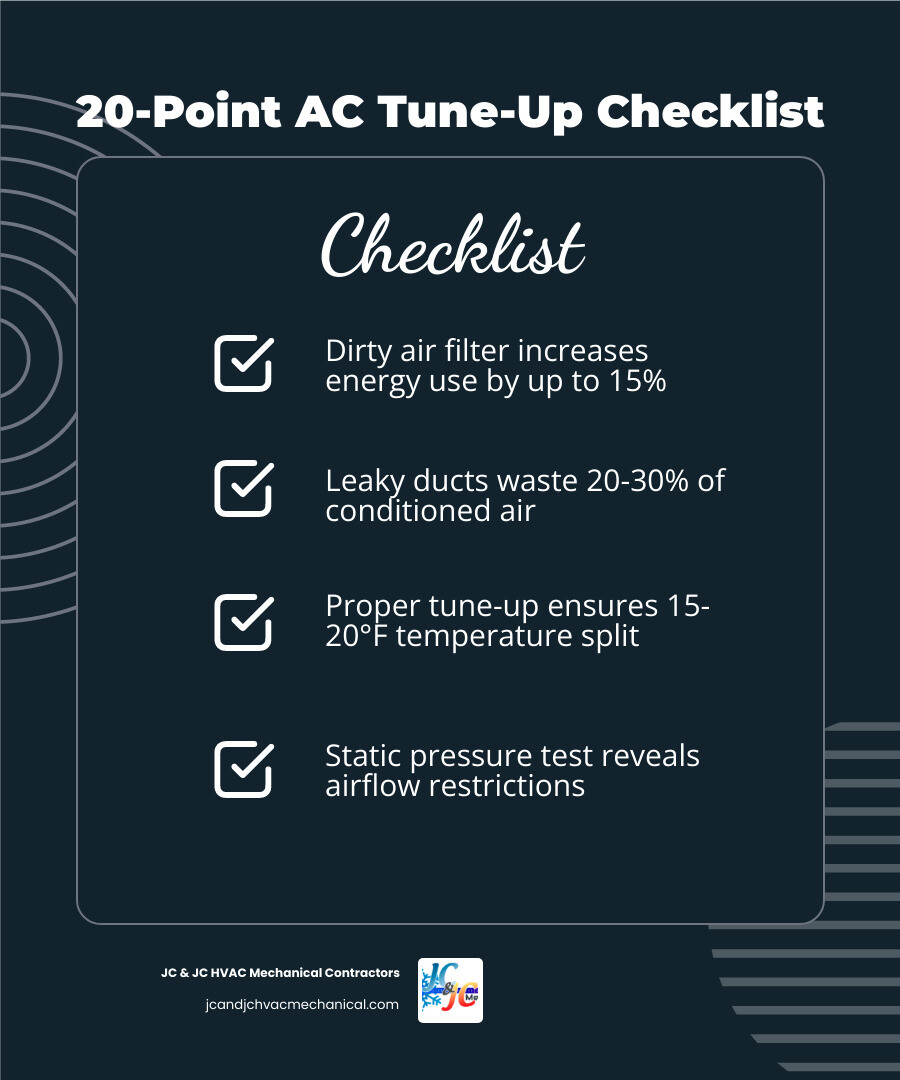
- Temperature split measurement – Confirm a 15–20°F difference between return and supply air
- Static pressure testing – Check for restricted airflow (“blood pressure” of your duct system)
- Moving parts lubrication – Reduce friction on motors and bearings
- Safety controls test – Verify overflow switches and pressure cutoffs work
- Ductwork visual inspection – Look for leaks or disconnected sections
- Outdoor unit platform check – Confirm the pad is level and stable
- Refrigerant line insulation – Inspect for damage that causes condensation and mold
- Compressor amperage check – Catch early signs of compressor strain
- Full system cycling test – Run the system start-to-finish and confirm performance
If you are a homeowner in the MD/DC area who has ever wondered whether your technician actually did all of that — or just walked around for 20 minutes — you are not alone. Many homeowners feel like passive bystanders during a maintenance visit, unsure what a real tune-up looks like versus a rushed one.
According to the U.S. Department of Energy, a dirty air filter alone can increase your system’s energy use by up to 15%. ENERGY STAR reports that leaky ducts can waste 20 to 30 percent of your conditioned air before it ever reaches your living spaces. These are not small problems — and they are exactly the kind of issues a proper tune-up is designed to catch before they turn into expensive repairs.
The checklist below will walk you through every item a qualified technician should inspect, explain why each one matters, and help you ask the right questions when they show up at your door.
Why an AC Tune-Up is Essential for Homeowners
It is easy to forget about your air conditioner when it is working fine. However, waiting for a breakdown in the middle of a humid July in Washington, D.C. is a recipe for a “panic call” and a very uncomfortable night. Regular maintenance is about more than just comfort; it is a financial strategy.
First, let’s talk about energy savings. A dirty system is a hungry system. When coils are layered in dust, they act like a thermal blanket, forcing the compressor to run longer and work harder to achieve the same cooling effect. By keeping these components clean, we ensure your system runs as efficiently as possible, which can lower your energy consumption by up to 15%.
Second, tune-ups are the secret to How Long Do Air Conditioners Last and How Can AC Tune-Ups Help? A well-maintained unit can last 15 to 20 years, whereas a neglected one often retires early around the 10-year mark. Think of it like a car: if you never change the oil, you can’t expect the engine to last.
Finally, there is the issue of indoor air quality. Americans spend roughly 90% of their time indoors, where pollutant levels can be 2 to 5 times higher than outdoor levels. Your HVAC system is your primary defense against these pollutants. Don’t Let Your AC Retire Early: Maintenance Tips for Longevity because a clean system doesn’t just cool your air—it filters it, helping your family breathe easier.
The Comprehensive AC Tune Up Checklist What Your Technician Should Check
When we arrive at your home in Rockville or Silver Spring, we don’t just look for what’s broken; we look for what’s about to break. A professional 20-point inspection is designed to be proactive.

Understanding What is Included in HVAC Maintenance and Why It’s Important allows you to hold your service provider accountable. A technician should spend 60 to 90 minutes on a standard residential system. If they are in and out in 20 minutes, they likely haven’t checked the critical safety controls or measured component wear accurately.
Critical Electrical and Control Inspections
The electrical side of your AC is where most “no-cool” calls originate. Specifically, capacitors and contactors are the most common failure points. Capacitors act like batteries that give your motors the “kick” they need to start. If they test 10% below their rating, they are failing and will likely quit on the hottest day of the year.
When Peeking Under the Hood of Your HVAC Maintenance Agreement, you should see that the technician is tightening all electrical connections. Vibration from normal operation can loosen wires over time, creating a fire hazard or causing the system to trip a breaker. We also check the disconnect box—the safety shutoff located near the outdoor unit. Per mechanical code, this box should be sealed with clear silicone on the top and sides to prevent water and pests from getting inside.
Mechanical Components and the AC Tune Up Checklist What Your Technician Should Check
Moving parts require physical inspection. The blower motor is the heart of your indoor unit, responsible for circulating air throughout your home. If the blower wheel is dirty, it’s like running with a heavy backpack on; the motor has to work much harder, leading to burnout.
During AC Maintenance, we also inspect the fan blades on the outdoor unit. If a blade is unbalanced or chipped (perhaps from a stray stone), the resulting vibration can actually crack refrigerant lines. We lubricate all moving parts that aren’t permanently sealed to reduce friction and electricity use, ensuring the system runs quietly and smoothly.
Refrigerant Levels and Coil Cleaning
Refrigerant is the “lifeblood” of your cooling system. A common misconception is that refrigerant is a fuel that gets “used up.” In reality, your AC is a hermetically sealed system. If the refrigerant is low, there is a leak.
At AC Maintenance Tune-Up Silver Spring MD, our technicians use precise digital gauges rather than old-fashioned analog ones. Digital gauges allow us to measure “subcooling” and “superheat,” which are technical metrics that tell us exactly how the refrigerant is performing.
We also focus heavily on the coils. The indoor evaporator coil absorbs heat, and the outdoor condenser coil releases it. If either is dirty, the heat transfer process fails. We use specialized brushes and cleaning solutions to clear away grime without damaging the delicate aluminum fins.
Performance Metrics and Technical Verification
How do we know the tune-up worked? We use data. After the cleaning and adjustments are finished, we run the system and measure its “vitals.”
| Metric | Optimal Range | Warning Sign |
|---|---|---|
| Temperature Split | 15°F – 20°F | Less than 15°F (Poor cooling) |
| Static Pressure | 0.5 iwc (varies by unit) | High pressure (Restricted airflow) |
| Amperage Draw | Within Manufacturer Spec | High Amps (Motor/Compressor strain) |
| Capacitor Rating | +/- 5% of Label | 10% or more below (Near failure) |
Performing Spring Maintenance to Prevent Summer Breakdowns and Costly Repairs means catching these metrics when they start to drift, rather than after the system has already failed.
Verifying Airflow and the AC Tune Up Checklist What Your Technician Should Check
Airflow problems can reduce your system’s efficiency by up to 15%. This is often caused by ductwork integrity issues. In older homes in Bethesda or Potomac, duct leaks can waste up to 30% of your cooled air.
The technician should perform a visual inspection of accessible ductwork to look for disconnected sections or sagging flex ducts. They should also flush the condensate drain line. This line removes the moisture your AC pulls out of the air. If it clogs with algae or debris, water can back up and cause massive damage to your ceilings and floors. A professional tune-up ensures the overflow safety switch is functional, so the system shuts down before a flood occurs.
DIY Maintenance Tasks to Handle Before Your Appointment
While technical tasks require a pro, there are several things you can do to help your system. We recommend going through The Ultimate Spring Cleaning Checklist for Your HVAC System every year.
- Change Your Filter: This is the single most important thing you can do. In dusty environments or homes with pets, check it every 30 days.
- Clear the Area: Ensure there is at least a 2-foot clearance around your outdoor condenser unit. Remove weeds, leaves, and grass clippings that can “suffocate” the unit.
- Check Batteries: If your thermostat has batteries, replace them annually to prevent the “brain” of your system from going dark.
- Unblock Vents: Make sure furniture or curtains aren’t blocking the indoor registers.
Learning How to Prep Your Home’s AC for the Summer Heat helps our technicians focus on the deep technical work during their visit rather than basic housekeeping.
Frequently Asked Questions about AC Tune-Ups
When is the ideal time of year to schedule an AC tune-up?
Spring is the absolute best time—specifically March through early May. Scheduling before the peak heat arrives ensures your system is ready for the first 90-degree day. If you find yourself asking, Is July Too Late to Get AC Maintenance Done?, the answer is no—maintenance is always better late than never—but you may have to wait longer for an appointment during the summer rush.
How often should you schedule a professional AC tune-up?
You should schedule a professional tune-up at least once a year. If you have a heat pump (which provides both heating and cooling), we recommend twice-yearly service—once in the spring and once in the fall. Regular maintenance is also a requirement for most manufacturer warranties; skipping it could void your coverage if a major component fails.
What are the red flags of a substandard tune-up?
Be wary of a technician who only stays for 15 or 20 minutes. A thorough inspection takes time. Other red flags include technicians who use only analog gauges (which are less precise), those who don’t provide a written report of their findings, or anyone who suggests “topping off” refrigerant without looking for a leak.
Conclusion
At JC & JC HVAC Mechanical Contractors, we take the ac tune up checklist what your technician should check seriously. Serving the Washington, D.C., and Maryland areas, we pride ourselves on professional, expert service backed by over 270 excellent reviews. We don’t just “check the boxes”—we ensure your system is optimized for the specific challenges of our local climate.
To make maintenance even easier, consider our Maintenance Agreement, which provides you with priority service and the peace of mind that your system is always in peak condition. Whether you are in Beltsville, Laurel, or Germantown, we are here to help you stay cool.
Ready to get your system ready for the heat? Schedule your AC Maintenance Tune-Up Washington DC with us today!