
Why the Building Process Is the Best Time to Plan Your AC System
How to plan your ac system during the building process is one of the most important decisions you’ll make as a new homeowner — and the window to get it right is shorter than most people realize.
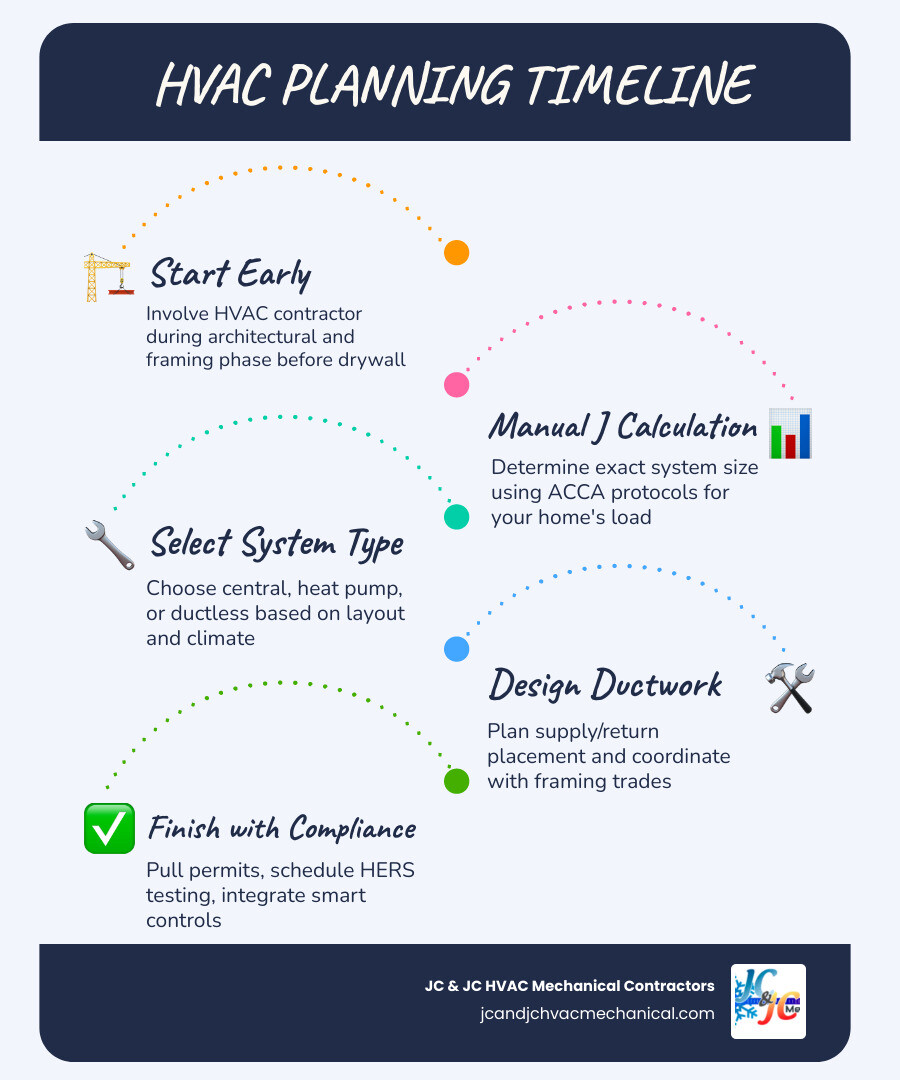
Here’s a quick overview of the key steps:
- Start early — Involve your HVAC contractor during the architectural and framing phase, not after drywall goes up
- Get a Manual J load calculation — This determines the correct system size for your specific home
- Choose the right system type — Central split, heat pump, or ductless mini-split based on your layout and climate
- Design ductwork before walls close — Plan supply registers, return air placement, and sealed duct runs with your framer
- Coordinate with other trades — Electrical, plumbing, and framing all need to work around your HVAC layout
- Plan for zoning — Multi-story or open-concept homes benefit from independent temperature zones
- Pull permits and schedule HERS testing — Required in most jurisdictions before final inspection
- Integrate smart controls — Thermostat placement and demand response features are easiest to wire during construction
Once the framing is up and drywall crews are scheduled, your options shrink fast. Duct runs get squeezed into tight chases, equipment ends up in awkward spots, and costly rework becomes the only fix. Research shows the average home loses 25% of its conditioned air through duct leaks — a problem that starts with poor planning, not poor luck. Getting your HVAC contractor involved before the first nail goes into framing isn’t just smart. It’s the single biggest factor in whether your home stays comfortable and efficient for the next 20 years.
The Foundation of Comfort: Manual J Load Calculations
When we talk about how to plan your ac system during the building process, we have to start with the math. In the old days, many contractors used a “rule of thumb” based strictly on square footage. In 2026, that simply doesn’t fly. Modern homes in the Washington, D.C. and Maryland area are built much tighter and with better insulation than homes from twenty years ago.
To ensure your home is comfortable, we use three critical protocols from the Air Conditioning Contractors of America (ACCA):
- Manual J: This is the “Load Calculation.” We look at your home’s orientation to the sun, the types of windows you’re installing, insulation R-values, and even how many people will live there. It tells us exactly how many BTUs of cooling your home needs.
- Manual S: Once we know the load, Manual S helps us select the specific equipment that matches those needs.
- Manual D: This is the blueprint for your ductwork, ensuring every room gets the right amount of airflow.
Properly using these tools is the only way to figure out How to Choose the Right Size HVAC Unit for Your Home.
Why Sizing Matters in 2026
You might think, “Why not just buy a bigger unit to be safe?” In the HVAC world, bigger is definitely not better. An oversized AC unit will “short-cycle,” meaning it turns on and off rapidly. Because it cools the air so fast, it doesn’t run long enough to remove humidity. In our humid Maryland summers, you’ll end up with a home that is cold but clammy—and a much higher energy bill.
By sticking to ACCA standards, we can achieve a 10–20% reduction in energy use. Correct sizing ensures the system runs long enough to dehumidify the air properly, providing that crisp, comfortable feeling we all want when we step inside from a July afternoon in Bethesda or Silver Spring.
How to Plan Your AC System During the Building Process: System Selection
Choosing your equipment is the next major step. Since you are building from scratch, you aren’t limited by what was there before. You have a clean slate to choose the most efficient technology available in 2026.
The three most common choices for new builds in our region are:
- Central Split Systems: The traditional choice. You have an indoor evaporator coil (usually sitting on top of a furnace or in an air handler) and an outdoor condenser unit.
- Air Source Heat Pumps: These are incredibly popular in the D.C. metro area. They provide both heating and cooling by moving heat rather than creating it. Modern heat pumps are efficient even in our colder winter months.
- Ductless Mini-Splits: Ideal for modern, open-concept homes or additions. These don’t require large duct runs and allow for incredible temperature control in individual rooms.
If you’re stuck between options, we often help homeowners learn How to Decide Between Central Air and Mini-Split Installation based on their specific blueprints.
Selecting the Right Technology for Your Build
In 2026, efficiency is measured by SEER2 (Seasonal Energy Efficiency Ratio 2). The higher the number, the less electricity the unit uses. For a new build, we highly recommend looking for ENERGY STAR certified models. These units are typically 15% more efficient than standard models.
We also suggest variable-speed compressors. Unlike a standard “on/off” unit, a variable-speed system can slow down or speed up depending on the cooling demand. This is Everything You Need to Know About Your New Home’s Comfort System: it provides more consistent temperatures and better air filtration because the air is moving more frequently at a lower, quieter speed.
Comparing Efficiency and Performance
| System Type | Efficiency (SEER2) | Best For | Installation Flexibility |
|---|---|---|---|
| Central AC | 14.3 – 22+ | Traditional layouts | Requires extensive ductwork |
| Heat Pump | 15 – 25+ | All-electric homes | Uses ducts or ductless |
| Mini-Split | 20 – 30+ | Zoned comfort | Very high; no large ducts |
In the Northern region (including D.C. and Maryland), minimum efficiency standards have risen, but we always recommend aiming higher than the minimum to future-proof your investment.
Ductwork Design and Trade Coordination Before Drywall
This is where the “timing” part of our title really kicks in. Ductwork is the circulatory system of your home. If it’s poorly designed, your expensive high-efficiency AC unit won’t be able to do its job.
When we design your ducts, we aren’t just looking for the shortest path. We are calculating “static pressure”—the resistance the fan has to overcome to push air through the vents. This is Why Ductwork Design is So Important; if the ducts are too small or have too many sharp turns, your system will work harder, make more noise, and die sooner.
During the “rough-in” phase, we coordinate closely with the framers and plumbers. We need to ensure that the “chases” (the spaces inside walls for ducts) are large enough and that we aren’t fighting for the same space as a drain pipe or a structural beam.
How to Plan Your AC System During the Building Process for Optimal Airflow
For the best results, we focus on three things during the Air Duct Installation Design phase:
- Sealing: We use “mastic” (a gooey, fiber-reinforced sealant) on every joint. Even a small leak can lead to that 25% energy loss we mentioned earlier.
- Insulation: Ducts running through unconditioned spaces (like an attic) must be wrapped in high-quality insulation (typically R-8) to prevent “sweating” and energy loss.
- Return Placement: Many builders put one giant “return” vent in a hallway. We prefer putting returns in every major bedroom. This prevents pressure imbalances that can make doors slam shut or create hot spots in the house.
Strategic Placement and Zoning for Multi-Zone Homes
Where you put your equipment matters just as much as what you buy. We want to place the indoor air handler in a central location to minimize the length of duct runs. For the outdoor unit, we look for a level, well-ventilated spot where the noise won’t bother you while you’re enjoying your backyard or trying to sleep.
This is also the time to talk about Zoning. If you are building a multi-story home in Rockville or Potomac, you know that heat rises. A single thermostat on the first floor will never be able to keep the second-floor bedrooms comfortable without freezing out the kitchen.
AC Installation in a new build allows us to install “dampers” inside the ductwork. These are motorized doors that open and close based on which part of the house needs cooling.
How to Plan Your AC System During the Building Process for Multi-Story Homes
Zoning allows you to have independent control over different areas of your home. You can keep the bedrooms cool at night while saving energy in the living areas. By planning this during the build, we can avoid the Ductwork Design Mistakes That Experts Can Prevent, such as trying to “force” a single-zone system to cool a three-story colonial.
Compliance, IAQ, and Smart Home Integration
Building a home involves a lot of paperwork, but it’s all for your safety and comfort. We handle the mechanical permits and ensure the system meets all local codes in D.C. and Maryland. This often includes HERS (Home Energy Rating System) testing, where a third party verifies that the ducts are sealed and the system is performing as promised.
Beyond the basics, we focus on Indoor Air Quality (IAQ). New homes are built so tight that they can actually trap pollutants inside. We often recommend:
- ERVs (Energy Recovery Ventilators): These bring in fresh, filtered outdoor air while exhausting stale indoor air, all without losing your cooled or heated energy.
- MERV 13 Filtration: High-efficiency filters that catch dust, pollen, and even some viruses.
- Humidity Control: Integrated dehumidifiers that keep your home in the “Goldilocks” zone of 45–55% humidity.
Selecting the right SEER rating is part of this, so it helps to know What is a Good SEER Rating for My New AC before the equipment is ordered.
Future-Proofing Your Home Environment
The HVAC industry is currently transitioning to low-GWP (Global Warming Potential) refrigerants to meet environmental standards. By planning your system now, we can ensure you are using the latest, most sustainable technology.
We also integrate smart thermostats that can participate in “demand response” programs. These programs can sometimes save you money by slightly adjusting your temperature during peak grid stress. If you’re currently in an older home, you might already see the 4 Signs It Might Be Time for New Air Conditioner Installation, but in a new build, you start with a clean, smart slate.
Frequently Asked Questions about New Build AC Planning
When is the best time to involve an HVAC contractor?
The best time is as soon as your architectural drawings are finalized. We want to see the prints before the foundation is even poured. This allows us to suggest changes to the framing or layout that could save you thousands in ductwork costs later. If you’re wondering When is the Best Time for AC Installation, the answer for a new build is “as early as possible.”
Can I use a ductless system for a whole new house?
Absolutely! Many modern, high-performance homes use ductless mini-splits exclusively. This allows for “true” zoning, where every room has its own thermostat. It’s a great way to avoid bulky ductwork and maximize ceiling heights in your new build.
What are the minimum efficiency standards for 2026?
As of 2026, the Department of Energy requires a minimum of 15 SEER2 for air conditioners in the northern regions (which includes D.C. and Maryland). However, we find that most of our clients in Bethesda and Silver Spring opt for 18 SEER2 or higher to maximize their long-term energy savings.
Conclusion
Building a new home is an exciting journey, and your HVAC system is the “heart” that keeps the environment healthy and comfortable. By understanding how to plan your ac system during the building process, you are setting yourself up for decades of worry-free comfort.
At JC & JC HVAC Mechanical Contractors, we specialize in professional AC Installation for new construction throughout Washington, D.C., Montgomery County, and Howard County. From the initial Manual J calculation to the final thermostat programming, our expert team is here to ensure your new build is the sanctuary you deserve.
Whether you are in Beltsville, Rockville, Potomac, Silver Spring, Bethesda, Laurel, or Germantown, we provide the expert, 24/7 service you need to get the job done right. Ready to start planning? Give us a call today!