
Why Proper AC Installation Affects Long Term Performance More Than Most Homeowners Expect
How proper AC installation affects long term performance is one of the most important questions any homeowner can ask before signing off on a new system. The short answer: installation quality shapes almost every outcome you care about — how long your system lasts, how much you pay each month to run it, how evenly your home cools, and how often you’re calling for repairs.
Here’s a quick summary of the key ways proper installation drives long-term results:
- System lifespan – A properly installed AC can last 15-25 years; poor installation can cut that to under a decade
- Energy efficiency – Correct sizing, sealed ducts, and precise refrigerant charge keep monthly bills as low as possible
- Comfort – Balanced airflow and correct equipment placement mean even temperatures throughout your home
- Reliability – Proper setup reduces compressor strain, refrigerant problems, and drainage failures that cause breakdowns
- Warranty protection – Following manufacturer installation guidelines keeps your coverage intact
Most homeowners focus almost entirely on which unit to buy. But a high-efficiency system installed incorrectly will underperform a mid-range system installed the right way — every single time. Research consistently shows that leaky or poorly designed ductwork alone can waste 20-30% of your cooling before it ever reaches a room. And since air conditioning can account for 50% or more of your electric bill during summer months, that waste adds up fast.
If you’re a homeowner in the Maryland or DC suburbs dealing with uneven cooling, high bills, or a system that seems to run constantly without ever quite catching up — the root cause is often the installation, not the equipment itself.
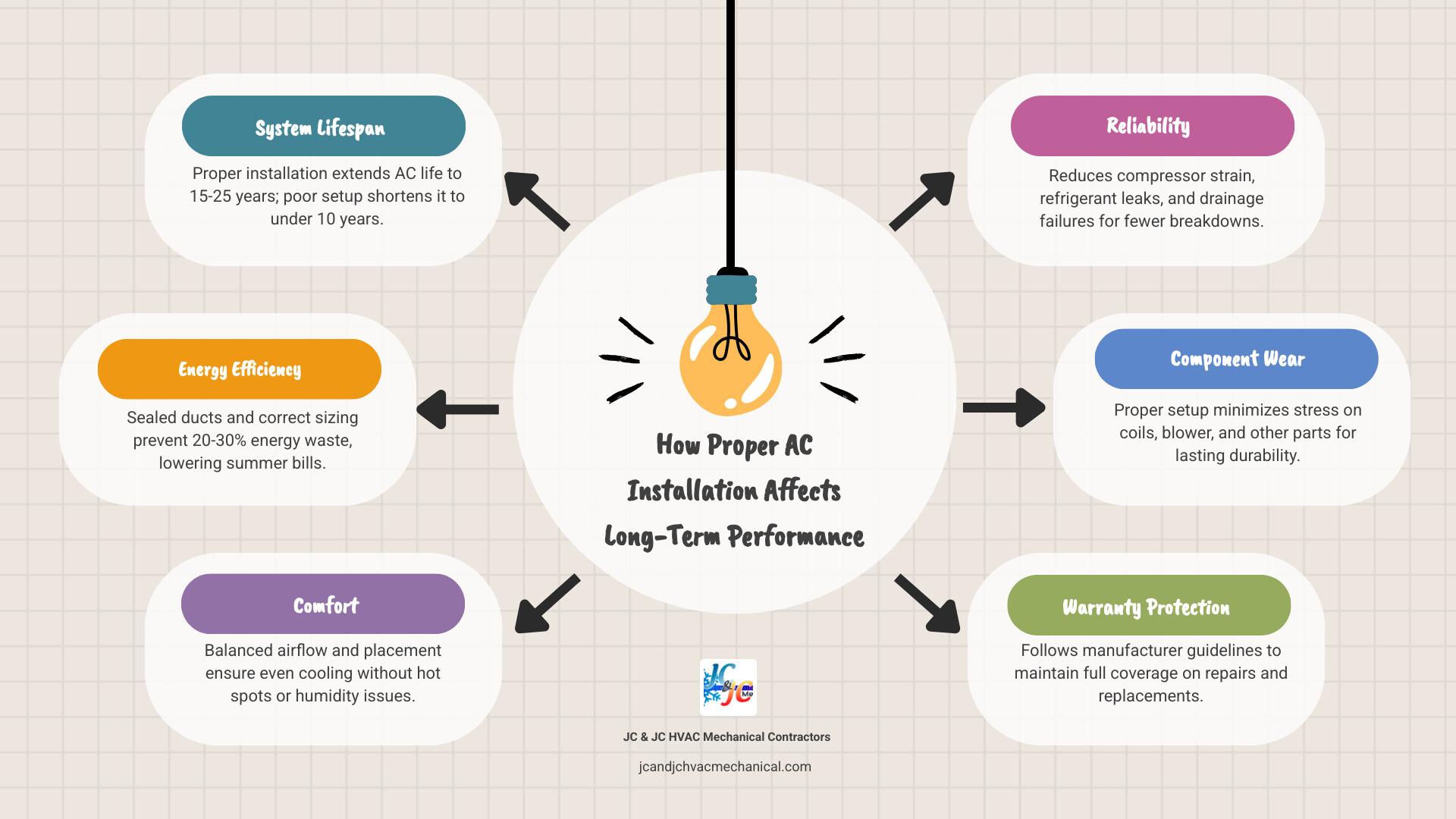
How Proper AC Installation Affects Long Term Performance

Proper installation is where long-term AC performance begins. It affects the system’s lifespan, monthly efficiency, wear on major parts, humidity control, airflow balance, and even whether warranty coverage holds up if a part fails later.
A well-installed system starts life with the right conditions:
- Correct capacity for the home
- Proper airflow across the indoor coil
- Accurate refrigerant charge
- Sealed and balanced ductwork
- Safe electrical connections
- Correct drain setup
- Smart equipment placement
When one or more of those steps is skipped, the problems usually do not stay small. They snowball. A little airflow restriction can lead to higher static pressure. That can strain the blower and reduce cooling delivery. Incorrect refrigerant can reduce heat transfer and overwork the compressor. Poor placement can cause hot rooms, noise, and maintenance headaches.
Why installation quality matters more than many homeowners realize
Air conditioners are designed to deliver certain performance numbers at the factory, but those numbers depend on real-world setup. In other words, the equipment can only do its job if the installation lets it.
That is why hidden installation defects are so frustrating. The system may cool “well enough” at first, but over time the warning signs show up:
- Uneven temperatures from room to room
- Frequent on-and-off cycling
- Sticky indoor humidity
- Rising electric use
- More service calls than a newer system should need
Many homeowners assume those issues mean they bought the wrong brand or need a bigger unit. Often, the actual issue is that the system was never installed to match the home.
Typical lifespan: properly installed AC vs poorly installed AC
Installation quality has a major effect on service life. Research commonly places the lifespan of a properly installed and maintained central AC system around 15-20 years, and in some cases 15-25 years. Poor installation can cut that down dramatically, sometimes to less than 10 years.
Window units tend to last less, usually around 8-10 years, while central systems generally last longer because they are designed for whole-home use. But even a durable central system will not reach its expected life if it short cycles, runs with bad airflow, or operates with an incorrect refrigerant charge.
Climate matters too. In Washington, DC, Montgomery County, and nearby Maryland areas, long humid summers mean heavy cooling demand. That makes proper installation even more important because mistakes get repeated every day the system runs.
| Installation quality | Likely long-term result |
|---|---|
| Proper sizing and setup | Better efficiency, steadier comfort, longer lifespan |
| Sealed and balanced ducts | Lower waste, stronger airflow, less wear |
| Correct refrigerant charge | Better heat transfer, reduced compressor strain |
| Poor sizing | Short cycling or nonstop runtime |
| Leaky ductwork | Cooling losses, high bills, uneven rooms |
| Bad charge or airflow | Frozen coils, breakdowns, early failure |
If you are planning a replacement, our pages on AC installation and when the best time for AC installation is can help you prepare.
Correct Sizing Is the Foundation of Long-Term Results
Sizing is not guesswork. It should be based on a proper load calculation that considers the home’s square footage, insulation, windows, orientation, layout, air leakage, and other heat-gain factors. If that sounds less exciting than “bigger is better,” that is because it is. It is also much more accurate.
For homeowners comparing options, we recommend reading How to Choose the Right Size HVAC Unit for Your Home.
How proper AC installation affects long term performance through correct sizing
When an AC is sized to match the actual cooling load, it can run in healthy cycles that cool the house evenly and remove humidity properly. That balance matters for comfort and for equipment life.
A correctly sized system helps by:
- Avoiding excessive startup stress from constant short cycles
- Running long enough to dehumidify effectively
- Preventing nonstop operation in peak heat
- Keeping temperatures more consistent
- Reducing unnecessary wear on motors and compressors
Oversized systems satisfy the thermostat too quickly, then shut off before removing enough moisture. Undersized systems can run for long stretches, especially during hot and humid weather, which increases wear and can still leave rooms uncomfortable.
Why a bigger unit is not a better unit
This is one of the most common installation myths. A larger AC does not mean better cooling. It often means worse humidity control, more temperature swings, and more stress on the equipment.
Here is what oversizing can cause:
- Short cycling
- Clammy indoor air
- Hot and cold spots
- Higher energy use from repeated starts
- More wear on contactors, capacitors, and compressors
On the other side, an undersized unit may run constantly and still struggle to keep up. Neither extreme is good for long-term performance. The “just right” answer is the one your home actually needs.
How efficiency ratings only help when the system is sized and set up correctly
SEER2 ratings matter, but they are only part of the picture. Since SEER2 standards became the required measure for new residential systems in 2023, homeowners have had a more realistic way to compare efficiency under real-world operating conditions. But even a strong SEER2 rating cannot rescue a poor installation.
Why? Because real efficiency depends on:
- Proper sizing
- Duct static pressure
- Airflow setup
- Refrigerant charge
- Thermostat placement
An improperly sized high-efficiency system can easily underperform compared with a correctly installed moderate-efficiency one. For more on efficiency selection, see What is a Good SEER Rating for My New AC.
Ductwork, Airflow, and Placement Decide Whether Cooling Stays Efficient
Ducts are the delivery system for your cooling. If they leak, are poorly sized, or create too much resistance, your AC has to work harder to move air and cool the home. Research shows that leaky or improper ductwork can waste about 20-30% of cooling efficiency.
That is a huge loss. Imagine paying to fill a bucket with a hole in it all summer.
For deeper reading, visit our pages on Ductwork Design and Why Ductwork Design is So Important.
How proper duct design and sealing protect efficiency and system longevity
Good duct design is about more than connecting point A to point B. It is about delivering the right amount of air to each space with as little waste and resistance as possible.
Proper duct design and sealing help:
- Reduce air leakage
- Prevent attic or crawlspace losses
- Lower static pressure
- Protect the blower from extra strain
- Improve room-to-room comfort
- Support better humidity control
Insulation matters too, especially where ducts run through very hot spaces. In our region, attic temperatures can climb well above outdoor air temperatures in summer, so uninsulated or poorly sealed ducts can lose cooling fast before it reaches the living area.
How proper AC installation affects long term performance with airflow and equipment placement
Airflow and placement shape comfort more than many people realize. The indoor equipment needs enough airflow across the evaporator coil. The outdoor unit needs clearance to reject heat properly. The thermostat needs to read the home’s real conditions, not a misleading hot wall or sunny hallway.
Good placement supports:
- Even cooling
- Lower noise
- Easier maintenance access
- Better drain performance
- Reliable thermostat readings
Outdoor units should have breathing room. Shade can help, but blockage is not the same thing as shade. A condenser surrounded by clutter or tight landscaping may struggle to release heat. Inside, the drain should be pitched correctly so water leaves the system instead of inviting leaks, mold, or ceiling stains.
Warning signs your ductwork or airflow setup was wrong from day one
Some problems show up almost immediately after installation. Others seem minor at first and become expensive later.
Common warning signs include:
- High electric bills despite a newer system
- Weak airflow from vents
- Rooms that are always hotter or colder
- Noisy ducts or whistling registers
- Excessive indoor dust
- Humidity that never seems under control
- Frequent coil freezing
- The system running constantly in moderate weather
If several of these sound familiar, the issue may be the installation itself, not just the age of the equipment.
Refrigerant Charge, Electrical Setup, and Drainage Prevent Premature Failures
Some of the most serious long-term AC problems begin in details homeowners never see: refrigerant setup, wiring, startup testing, and condensate drainage. These are not glamorous topics, but they matter a lot. The compressor certainly thinks so.
For service details, visit our AC Installation page.
Why precise refrigerant charging is essential for efficiency and durability
Refrigerant charge must be set to the manufacturer’s specifications, not guessed. If the system is undercharged or overcharged, performance suffers and major components can be damaged.
Improper charge can lead to:
- Reduced cooling capacity
- Poor heat transfer
- Frozen evaporator coils
- Compressor overheating
- Higher energy use
- Premature compressor failure
Proper charging is verified using measured system conditions, including superheat and subcooling where appropriate. This is one of the clearest examples of how proper AC installation affects long term performance: a small setup error can create years of strain.
The installation details that often cause years of avoidable AC problems
Several installation mistakes can create recurring problems long after the crew leaves:
- Loose electrical connections
- Incorrect voltage or poor wiring practices
- Improperly sloped or clogged drain lines
- Line set issues
- Unbalanced airflow
- Incomplete startup testing
- Code or manufacturer guideline violations
These issues can show up as nuisance shutdowns, water leaks, mold risk, loud operation, shortened component life, or ongoing comfort complaints. In many homes, recurring service problems begin with one of these hidden setup errors.
Why professional installation helps protect manufacturer warranty coverage
Warranty protection is another reason installation quality matters. Manufacturers generally expect systems to be installed according to their requirements. If installation shortcuts caused the failure, warranty claims may be much harder to support.
Professional installation helps by:
- Following manufacturer instructions
- Documenting setup and testing
- Using approved procedures
- Creating a record of service and maintenance
- Reducing the chance of preventable damage
This is not just paperwork. It is part of protecting your investment over the long haul.
Climate, Maintenance, and Replacement Decisions Over the Life of the System
A properly installed AC gets the best possible start, but long-term results still depend on climate, maintenance, and knowing when repair no longer makes sense.
For more on lifespan and upkeep, see How Long Do Air Conditioners Last and How Can AC Tune-Ups Help and AC Maintenance.
How climate and location increase the need for proper installation
In Washington, DC, Montgomery County, and Howard County, air conditioners deal with hot, humid summer weather and long cooling seasons. That means systems often run hard for months, and installation mistakes are exposed quickly.
Regional conditions increase the need for:
- Strong humidity removal
- Correct condensate drainage
- Reliable airflow in hot attics
- Duct insulation where needed
- Careful equipment placement for urban lots and tighter property spacing
Location can also affect lifespan. Coastal exposure is known to increase corrosion risk, and while our main service area is not fully coastal, any environment with heavy moisture, pollution, or prolonged summer use can increase equipment stress.
Maintenance habits that maximize the benefits of a properly installed AC
A great installation is not a “set it and forget it” situation. Routine care helps the system keep the advantages it started with.
Important maintenance habits include:
- Replacing or cleaning filters regularly
- Keeping the outdoor unit free of debris
- Checking thermostat operation
- Clearing drain lines
- Scheduling annual professional tune-ups
- Verifying airflow and refrigerant performance when needed
- Cleaning evaporator and condenser coils
Coil cleaning alone can make a meaningful difference. Research shows that cleaning evaporator and condenser coils can improve heat exchange and reduce energy consumption by up to 30% in some cases.
When installation-related issues mean replacement deserves consideration
Sometimes the installation problems are so baked in that repair after repair becomes a bandage on a bigger issue. Replacement may deserve serious consideration when you have:
- Frequent breakdowns
- Persistent hot or humid rooms
- Chronic short cycling
- Recurring water leaks
- Ongoing duct or airflow problems
- Major warranty concerns
- Aging equipment with a long history of poor performance
If the system is older and has never cooled evenly, has always had high energy use, or keeps developing the same issues, replacement may be the more practical long-term move. Our guide on 4 Signs It Might Be Time for New Air Conditioner Installation can help you evaluate the next step.
Frequently Asked Questions About How Proper AC Installation Affects Long Term Performance
Can poor installation really make a newer AC fail early?
Yes. Poor sizing, bad airflow, incorrect refrigerant charge, and wiring or drainage issues can all create premature wear. A newer system is not immune to installation mistakes. In fact, new equipment installed incorrectly can start underperforming right away and may fail much earlier than expected.
Will proper installation lower electric bills even if the equipment is not brand new?
Often, yes. Improving airflow, sealing ducts, correcting refrigerant charge, and fixing setup problems can help an existing system run more efficiently. While age still matters, proper setup and maintenance can reduce waste and improve comfort without requiring the system to work as hard.
What should homeowners check before scheduling a new installation?
Before moving forward, we recommend asking these pre-installation questions:
- Has a full load calculation been done?
- Will the existing ductwork be evaluated for leaks, sizing, and airflow?
- Where will the thermostat be located?
- Is there enough clearance around the outdoor unit?
- How will condensate drainage be handled?
- Will the installer verify refrigerant charge and airflow at startup?
- Will the final setup follow manufacturer guidelines?
- Will the system be easy to access for future maintenance?
If you are early in the planning process, these resources may help:
- How to Decide Between Central Air and Mini-Split Installation
- AC Installation Replacement Washington DC
- AC Installation Replacement Silver Spring MD
- AC Installation Replacement Bethesda MD
- The Coolest Guide to AC Installation in Beltsville MD
- Chilling Out with a New AC Installation in Bethesda MD
Conclusion
The long game of air conditioning is simple: the way a system is installed has everything to do with how it performs years later. Proper sizing, duct design, airflow, refrigerant setup, placement, drainage, and maintenance support all work together to deliver the results homeowners actually want – steady comfort, manageable energy use, fewer breakdowns, and a longer equipment life.
That is the real answer to how proper AC installation affects long term performance. It affects almost everything.
At JC & JC HVAC Mechanical Contractors, we help homeowners across Washington, DC, Montgomery County, and Howard County make smart installation decisions that support comfort and reliability for the long run. If you are planning a new system or replacing one that has never performed the way it should, learn more about our AC installation services.