
Why Knowing How Ductwork Is Evaluated During AC Replacement Can Save You Money and Comfort
How ductwork is evaluated during AC replacement is one of the most important — and most overlooked — parts of upgrading your home’s cooling system. Here’s a quick summary of what that evaluation covers:
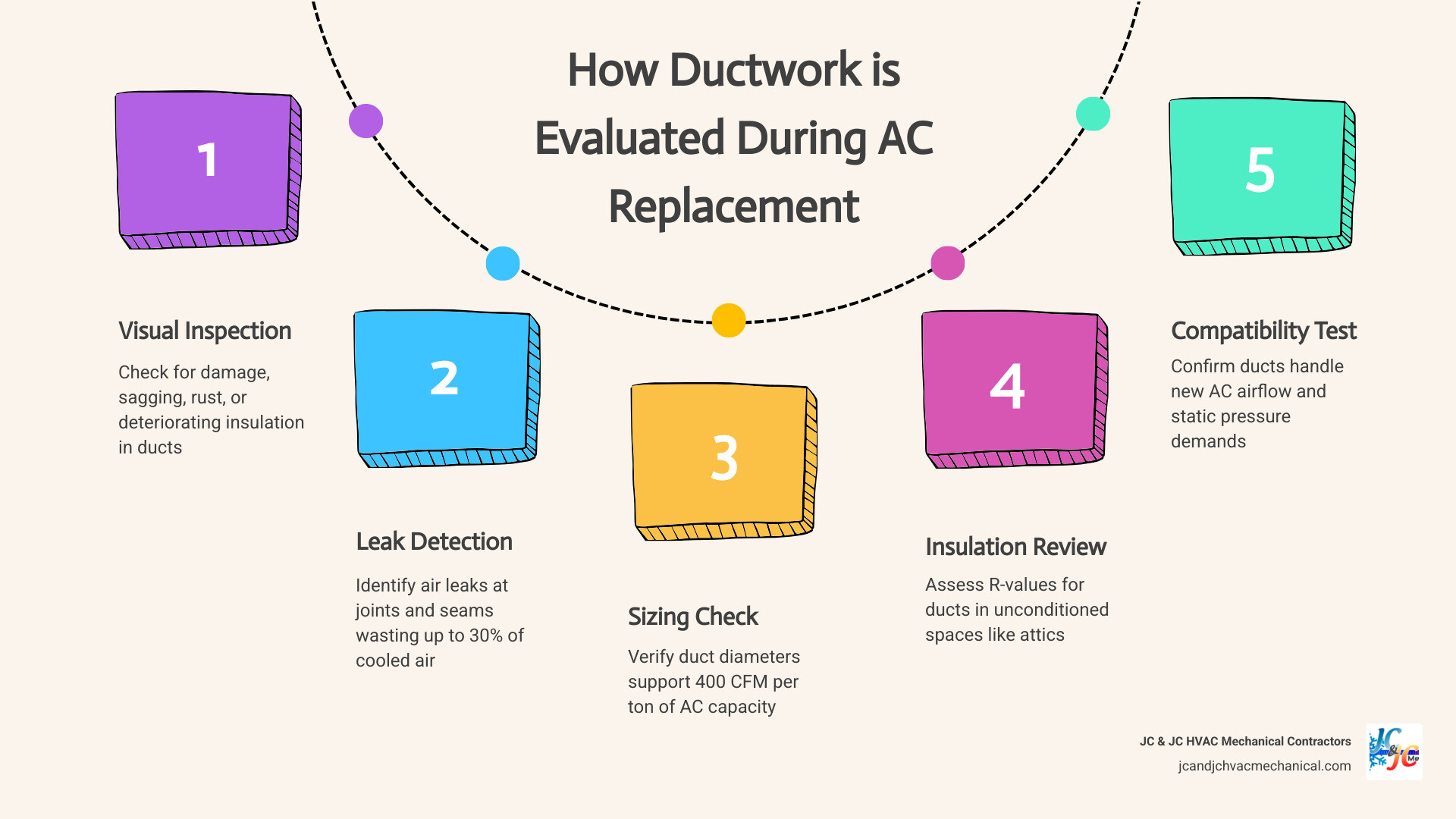
How professionals evaluate ductwork during AC replacement:
- Visual inspection — Checking for visible damage, sagging, disconnected sections, rust, or deteriorating insulation
- Leak detection — Identifying air leaks at joints, seams, and connections that waste conditioned air
- Sizing check — Verifying duct diameters support the required airflow (minimum 400 CFM per ton of AC capacity)
- Insulation review — Assessing R-values, especially for ducts running through unconditioned spaces like attics
- Compatibility assessment — Confirming existing ducts can handle the airflow demands of the new AC unit
- Static pressure measurement — Detecting airflow resistance that could strain a new system
Imagine spending thousands on a brand-new air conditioner, only to find that certain rooms still feel stuffy in July while others are freezing. That’s a real scenario that homeowners in the MD/DC suburbs face every summer — and the culprit is almost never the new AC unit itself. It’s the ductwork hiding behind the walls and above the ceilings.
Your duct system is the hidden highway that carries cooled air from your AC to every room in your home. If that highway has potholes, wrong-sized lanes, or leaking walls, even the most efficient new AC unit will underperform. And since both AC units and ductwork typically last around 10 to 15 years, there’s a good chance your ducts are due for a close look right when your AC is ready for replacement.
Why Ductwork Evaluation is Critical During AC Replacement
Think of your new air conditioner as a high-performance sports car engine. If you drop that engine into a car with a clogged exhaust and tiny, worn-out tires, you aren’t going to get the speed or efficiency you paid for. In the HVAC world, your ducts are those tires and exhaust.
When we look at why ductwork design is so important, the primary reason is energy efficiency. If your ducts are leaky or poorly insulated, you could be losing 20% to 30% of your cooled air before it ever reaches your bedroom. That is essentially like throwing money out of a window. By evaluating the ducts during a replacement, we ensure the new unit doesn’t have to run longer cycles just to compensate for “lost” air.
System lifespan is another major factor. Modern AC units are designed for specific airflow volumes. If the ducts are too small, it creates high “static pressure”—which is basically the HVAC version of high blood pressure. This forces the blower motor to work harder, leading to premature failure and expensive repairs just a few years into the new unit’s life.
Furthermore, the indicators of ineffective ductwork design, such as sharp turns or excessive flexible ducting, can create massive airflow resistance. If the cooling load of your home has changed since the original ducts were installed—perhaps you added a sunroom or finished a basement—the old layout might no longer be capable of keeping up.
How Ductwork is Evaluated During AC Replacement: The Professional Process
When we arrive at a home in Bethesda or Silver Spring for an AC consultation, we don’t just look at the outdoor condenser. We head straight for the attic, crawlspace, or basement.
The process of how ductwork is evaluated during AC replacement begins with a thorough visual inspection. We look for the obvious: disconnected pipes, crushed flex ducts, or rusted metal. But we also look for the subtle signs, like “dust tracking” near joints, which indicates air is whistling out of a gap.
During this phase, we also check the insulation R-values. In our region, temperature swings are significant. If your ducts have an old R-2 or R-4 rating (common in older homes), they won’t keep the air nearly as cold as modern R-8 insulated ducts. We also verify the integrity of the vapor barrier—that outer silver or gray sleeve. If it’s torn, moisture can seep in, leading to mold and a nasty “wet sock” smell in your home.
For homeowners considering ductwork installation in Washington DC, we pay special attention to how the ducts are strapped and supported. Sagging ducts create “bellies” that trap air and reduce velocity. These are exactly the kind of ductwork design mistakes that experts can prevent by ensuring every run is straight and properly tensioned.
How ductwork is evaluated during AC replacement for sizing
Sizing is where the math happens. We use “Manual D” calculations to ensure the ductwork can physically handle the volume of air the new AC produces.
A common issue we see involves trunk lines and branch ducts. The trunk line is the main “artery” of the system, while the branches are the smaller “veins” leading to individual rooms. If you are upgrading from an old 2.5-ton system to a 3-ton system, your existing trunk line might be too narrow. When performing ductwork design in Silver Spring MD, we check the friction rate—essentially how much the air slows down as it travels through the pipe.
If the air duct installation design is restricted, the air won’t have enough “push” to reach the far corners of your home. We calculate the required CFM (Cubic Feet per Minute) for each room to make sure the branch ducts are sized correctly for the space they serve.
How ductwork is evaluated during AC replacement for compatibility
Compatibility is about more than just size; it’s about technology. Modern AC units often use variable-speed blower motors. These motors are incredibly efficient, but they are also sensitive.
We look at HVAC ductwork principles your contractors should know to ensure the return air capacity matches the supply side. A very common mistake is having a massive supply system but a tiny return vent. This “starves” the AC unit of air, causing it to freeze up. We also count the supply registers. If a new high-efficiency unit requires more airflow than your current registers can vent, the system will become noisy, whistling like a tea kettle every time it turns on.
Technical Standards: Sizing and Airflow Requirements
In the HVAC industry, the gold standard for airflow is 400 CFM per ton. If you’re installing a 3.5-ton AC unit, your duct system needs to be able to move 1,400 CFM (3.5 x 400).
To give you an idea of how we check this, consider this table for a standard residential system at a 0.1 friction rate:
| Duct Diameter (Round) | Approx. CFM Capacity |
|---|---|
| 6 inch | 100 CFM |
| 8 inch | 200 CFM |
| 10 inch | 300 CFM |
| 12 inch | 500 CFM |
| 14 inch | 700 CFM |
| 16 inch | 1,050 CFM |
If we see a 3.5-ton system (needing 1,400 CFM) connected to a single 16-inch return duct, we know immediately that the system is undersized. That 16-inch duct can only handle about 1,050 CFM, leaving the system 350 CFM short. This is why a deep breath into ductwork design and airflow is so vital; without these measurements, you’re just guessing.
When we perform ductwork design in Washington DC, we also monitor return duct velocity. If air moves too fast through the return, it creates a loud “whooshing” sound. We aim for a “low and slow” approach for returns to keep your home quiet and comfortable.
Repair vs. Replacement: Making the Right Choice for Your Home
One of the most frequent questions we get is: “Do I really need to replace the whole thing?” The answer depends on the age and condition of the materials.
Ductwork generally has a lifespan of 15 to 20 years. Since most AC units last 10 to 15 years, the two often reach the end of their lives at the same time. If your ducts are made of old gray flex material from the early 2000s, the inner plastic liner is likely becoming brittle and flaking off into your air. In this case, replacement is the only logical choice.
However, if the “bones” of the system are good—perhaps you have sturdy sheet metal trunks—we might suggest repairs instead. This could involve mastic sealing (a thick, gooey paste that hardens to seal leaks) or adding more insulation. When deciding should I insulate my old ducts or install new ones?, we look at the cost-benefit ratio. If the labor to seal and insulate old, poorly-sized ducts costs nearly as much as new ones, we recommend starting fresh.
For residents looking for ductwork installation in Bethesda MD or ductwork installation in Silver Spring MD, we provide a clear assessment of what can be saved and what needs to go to ensure your new AC performs at its peak.
Common signs that indicate ductwork needs inspection
You don’t always need a technician to know there’s a problem. Keep an eye (and ear) out for these red flags:
- Uneven Temperatures: If the master bedroom is a sauna while the living room is a walk-in freezer, your ducts are likely unbalanced or leaking.
- Whistling or Rattling: These sounds often mean your ducts are too small for the air volume or have loose connections.
- Excessive Dust: If you clean your house and a layer of dust appears the next day, your return ducts might be pulling in dust from the attic through leaks.
- High Utility Bills: If your bills keep climbing despite a relatively new AC, the “hidden highway” is likely leaking money.
- Visible Sagging: If you peek into your crawlspace and see ducts lying on the ground or pinched over beams, they need professional attention.
You can learn more about these issues on our main ductwork/ service page.
Frequently Asked Questions about Duct Evaluation
What are the risks of using undersized ducts with a new AC?
Using undersized ducts is like trying to breathe through a cocktail straw while running a marathon. It creates high static pressure, which can lead to:
- Premature compressor failure: The heart of your AC wears out years too early.
- Frozen evaporator coils: Lack of airflow causes the coils to drop below freezing, turning your AC into a block of ice.
- Reduced airflow: You’ll feel a pathetic breeze coming out of the vents instead of a strong flow.
- Noise: The air will sound “angry” as it struggles to squeeze through tight spaces.
How long does a professional ductwork inspection take?
A thorough evaluation usually takes between 45 and 90 minutes. This isn’t just a quick glance; it involves a visual assessment of all accessible runs, airflow testing at the registers, and a sizing verification against your new AC unit’s specifications. We wrap it all up with a compatibility check and a comprehensive report for you.
Can I keep my old ducts if I upgrade to a high-efficiency AC?
Maybe! It depends on three things: Airflow, SEER2 compatibility, and Insulation. Modern high-efficiency units (SEER2 rated) often require more precise airflow than older models. If your old ducts are leaky or have low R-value insulation, they will negate the energy savings of your expensive new AC. We always recommend professional verification before making that call.
Conclusion
At JC & JC HVAC Mechanical Contractors, we believe that an AC replacement is only as good as the ducts it’s connected to. We don’t just “swap boxes”—we look at the entire “circulatory system” of your home to ensure you get the comfort and efficiency you deserve.
Whether you are in Washington D.C., Rockville, or Laurel, our team provides expert system matching and professional airflow optimization. We’ve built our reputation on professional service and over 270 excellent reviews by treating every home like our own.
Don’t let a “hidden highway” of leaky, old ducts stand in the way of your summer comfort. Schedule your professional AC installation and ductwork evaluation today and experience the difference that proper design makes.