
What Really Happens When Your Old AC Is Removed and a New System Installed
How your old AC is removed and new system installed is a process that most homeowners in the MD/DC area never think about — until the system dies on the hottest day of the year.
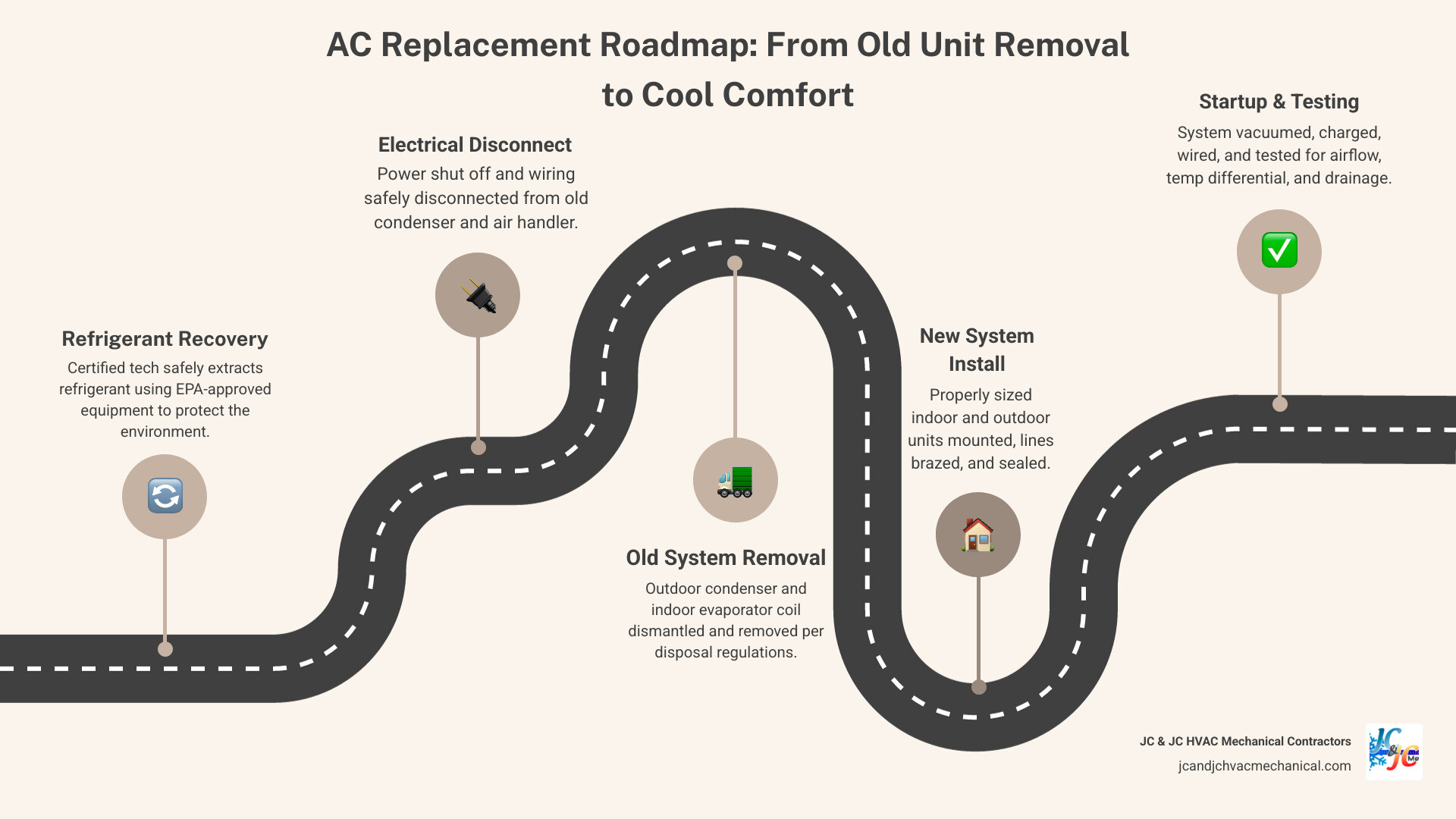
Here’s a quick overview of what the process looks like:
- Refrigerant recovery – A certified technician safely extracts refrigerant from the old system using EPA-approved equipment
- Electrical disconnect – Power to the unit is shut off and all wiring is safely disconnected
- Old system removal – The outdoor condenser and indoor air handler/evaporator coil are disconnected and removed
- Load calculation – The right size for your new system is determined based on your home’s specific needs
- New system installation – The new indoor and outdoor components are mounted, connected, and sealed
- Refrigerant lines connected and charged – Line sets are brazed, pressure-tested, vacuumed, and filled with refrigerant
- Electrical and thermostat wiring – All controls are wired and calibrated
- System startup and testing – Airflow, temperature differential, and drainage are verified before the technician leaves
Most standard replacements wrap up in a single day.
If your system is 10 to 15 years old or older, you’re in the majority of homeowners facing this decision soon. Nearly 88% of U.S. homes use air conditioning, and two-thirds depend on central AC as their main cooling source. When those systems age past their prime, energy bills climb, repairs multiply, and comfort suffers. A properly sized, high-efficiency replacement can cut your cooling costs by 20% to 50% — but only if the job is done right.
This guide walks you through every step, from pulling the old unit to the moment your new system blows cool air for the first time.
Signs It’s Time to Say Goodbye to Your Old Unit

It’s easy to ignore the hum of an outdoor condenser until it starts sounding like a blender full of marbles. In our experience serving areas from Rockville to Silver Spring, we see many homeowners trying to squeeze one last season out of a unit that is clearly on its last legs.
But how do you know when you’ve reached the point of no return?
First, consider the age. Most HVAC systems have a lifespan of about 10 to 15 years. While some “miracle” units in Bethesda or Potomac might last 20 years with perfect maintenance, they are usually incredibly inefficient by that point. If your system was installed before 2012, it’s likely using outdated technology and costing you a fortune in electricity.
Another major red flag is the frequency of repairs. We often suggest the “$5,000 rule”: if the cost of your repairs multiplied by the age of the unit exceeds $5,000, it is usually time to replace it. For example, a $600 repair on a 12-year-old unit ($7,200) suggests replacement is the smarter financial move. You can read more about these indicators in our guide on 4 Signs It Might Be Time for New Air Conditioner Installation.
Rising energy bills are the silent “check engine light” of the HVAC world. If your usage hasn’t changed but your Pepco or BGE bill is climbing every summer, your AC is likely struggling to keep up. This inefficiency often leads to uneven cooling—where your living room feels like a refrigerator but your upstairs bedroom in Laurel feels like a sauna.
Lastly, don’t ignore humidity issues. A properly functioning AC doesn’t just cool the air; it dehumidifies it. If your home feels “sticky” or you notice a musty smell, the evaporator coil may no longer be effectively removing moisture. For a deeper dive into this decision, check out When Is It Time to Consider a Heating System or AC Installation?. Upgrading to a modern, high-efficiency model can lead to 20% energy savings almost immediately.
The Professional Process: How Your Old AC is Removed and New System Installed
Once you’ve decided to upgrade, the actual “booting” of the old system begins. This isn’t just a matter of hauling away heavy metal; it’s a highly regulated technical process.
Step 1: Refrigerant Recovery
The most critical part of the removal is handling the refrigerant. Per EPA Section 608 regulations, it is illegal to “vent” refrigerant into the atmosphere. Our technicians use specialized recovery machines and tanks to vacuum out every ounce of the old Freon. This is especially important for older systems using R-22, which is being phased out due to environmental concerns.
Step 2: Electrical and Mechanical Disconnect
After the refrigerant is safely contained, we move to the electrical. We shut off power at the main breaker and the outdoor disconnect box. We then disconnect the high-voltage wiring and the low-voltage thermostat wires. This is also when we cut the copper “line sets” that connect the indoor and outdoor units.
Step 3: Dismantling the Indoor Components
Most homes in Washington D.C. or Germantown have an indoor air handler or a furnace with an evaporator coil mounted on top. We dismantle the blower motor and remove the old evaporator coil. This is often the messiest part of the job, as old coils can be caked with dust and debris from a decade of use. We take great care to protect your floors with drop cloths during this stage.
Step 4: Removal and Disposal
The heavy lifting follows. The old outdoor condenser is removed from its pad, and the indoor components are hauled out. At JC & JC HVAC Mechanical Contractors, we handle the responsible disposal of all old equipment. We ensure the metal is recycled and any hazardous materials are processed according to local Maryland and D.C. environmental codes. Instead of a “quick fix,” we focus on a clean slate. You can learn why this is better than constant patching in our article, Stop Patching the Leaks and Know When to Replace Your HVAC.
If you are located in the suburbs, you might find specific local requirements for these replacements; for instance, see our page on AC Installation & Replacement Silver Spring MD.
Setting the Foundation for Your New Cooling System
Before we can slide the new unit into place, we have to ensure the environment is ready for modern technology. A “plug and play” approach rarely works with HVAC because today’s systems are much more sensitive to airflow and sizing than the ones built 20 years ago.
The Shift in Technology
| Feature | Old R-22 Systems | Modern R-410A / R-454B Systems |
|---|---|---|
| Refrigerant Type | Hydrochlorofluorocarbon (Ozone-depleting) | Hydrofluorocarbon or A2L (Environmentally friendlier) |
| Efficiency (SEER2) | Typically 8 – 10 SEER | Minimum 13.4 SEER2 (Up to 25+) |
| Compressor Type | Single-stage (On/Off) | Variable-speed or Two-stage |
| Operating Pressure | Lower pressures | Much higher pressures (Requires thicker copper) |
Manual J Load Calculation
One of the biggest mistakes an installer can make is simply “matching” the size of the old unit. If your home in Beltsville has had new windows installed or added insulation since the last AC was put in, your cooling needs have changed. We perform a Manual J load calculation, which accounts for square footage, ceiling height, window orientation, and even the local climate in the Washington D.C. area. An oversized unit will “short-cycle” (turning on and off too fast), which leads to high humidity and a shorter lifespan for the compressor.
Ductwork and Pads
We also perform a thorough ductwork inspection. If your ducts have leaks or are too small for the higher airflow of a modern high-efficiency blower, the new system will struggle. We often seal leaks or modify plenums during the installation. Outside, we ensure the concrete or composite pad is perfectly level. A tilted condenser can cause oil to pool in the wrong place, leading to premature compressor failure. For more on local standards, see The Coolest Guide to AC Installation in Beltsville MD and our services for AC Installation & Replacement Washington DC.
Step-by-Step: How Your Old AC is Removed and New System Installed
Now we get to the “new” part of how your old AC is removed and new system installed.
- Indoor Unit Placement: We begin by installing the new evaporator coil and air handler. If it’s a split system, the coil is carefully mounted to your furnace. We ensure the “plenum” (the box that connects the unit to your ducts) is airtight using professional-grade foil tape and mastic sealant.
- Outdoor Condenser Mounting: The new condenser is placed on the leveled pad. We maintain specific clearances—usually 12 to 24 inches from the house—to ensure the unit can “breathe.” Proper airflow is the difference between a system that lasts 15 years and one that dies in 7.
- Line Set Installation: We either install new copper line sets or thoroughly flush the existing ones using a specialized cleaning agent. Since modern refrigerants use different oils than old ones, any leftover residue can “gum up” the new system.
- Brazing Connections: Instead of simple soldering, we “braze” the copper joints using a high-temperature torch and silver-alloy rods. This creates a high-pressure seal that can withstand the intense demands of modern refrigerants. During this process, we flow nitrogen through the pipes to prevent oxidation (soot) from forming inside the lines.
Residents in specialized areas like Bethesda can find more localized info here: AC Installation & Replacement Bethesda MD.
Finalizing the Process: How Your Old AC is Removed and New System Installed
Once the physical components are in place, the “science” phase begins.
- Nitrogen Pressure Test: We fill the system with high-pressure nitrogen to check for any tiny leaks in our brazed joints. We let it sit to ensure the pressure holds steady.
- The Vacuum (Evacuation): This is the most skipped step by cut-rate installers, but we never miss it. We use a vacuum pump to remove all air and moisture from the lines. Moisture is the “kryptonite” of an AC system; if left inside, it can turn into acid and eat the motor windings from the inside out. We pull the system down to at least 500 microns.
- Refrigerant Charging: Once we are sure the system is bone-dry and leak-free, we release the refrigerant. We use digital gauges to “weigh in” the charge based on the length of the line set, ensuring the system operates at peak efficiency.
- Electrical and Controls: We wire the new outdoor disconnect and connect the indoor control board. This is also when we install your new thermostat. Whether it’s a basic digital model or a smart Wi-Fi thermostat, we ensure it is calibrated to talk to your new equipment correctly. For a look at how we handle these final touches, see Chilling Out with a New AC Installation in Bethesda MD.
Testing, Cleanup, and Homeowner Walkthrough
The job isn’t done just because the air is cold. We put the system through a rigorous “startup” protocol.
We measure the temperature differential (the “Delta T”). This is the difference between the air going into the return vent and the air coming out of the supply vents. Ideally, we want to see a drop of 16 to 20 degrees. We also use a flow hood to measure the airflow (CFM) to ensure every room in your house is getting its fair share of the breeze.
Next comes the cleanup. We believe a professional HVAC company should leave your home cleaner than they found it. We sweep up any metal shavings, remove all cardboard packaging, and haul away the old unit.
Finally, we perform a homeowner walkthrough. We’ll show you:
- How to operate your new thermostat.
- Where your new filters are located and how often to change them (usually every 1-3 months).
- How to check the condensate drain line to prevent water damage.
- What the “normal” sounds of your new high-efficiency unit should be.
Knowing the right time to schedule this can save you a lot of stress. Check out Beat the Summer Rush: Replace Your HVAC System Before the Heat Sets In and When is the Best Time for AC Installation? to plan your project effectively.
Frequently Asked Questions about AC Replacement
How long does a typical AC replacement take?
For a standard residential home in Montgomery County or D.C., a full replacement usually takes 8 to 14 hours.
- Simple Swap: If the ductwork is in great shape and the electrical is up to code, we can often finish in a single day (starting at 8 AM and wrapping up by 4 PM).
- Complex Jobs: If we need to modify ductwork, install a new circuit at the breaker panel, or if the unit is in a difficult-to-reach attic or crawlspace, it may stretch into a second day.
- Weather Delays: Since we are working with high-voltage electricity and sensitive refrigerants, heavy rain can sometimes pause the outdoor portion of the install for safety.
What permits and inspections are required?
In our service area, most jurisdictions (like Montgomery and Howard Counties) require mechanical and electrical permits.
- Why they matter: Permits ensure that a third-party inspector verifies the work is safe and meets local building codes. This protects your home’s resale value and ensures your insurance remains valid.
- The Inspection: Usually, a few days after we finish, a local inspector will stop by to check the wiring, the refrigerant line sets, and the drainage. We handle the permit filing for you. You can read more about our professional standards on our AC Installation page.
How should I prepare my home for installation day?
You can help the process go faster by doing a few simple things:
- Clear the Path: Ensure there is a clear walking path from the entrance to the indoor unit (basement or attic).
- Clear the Outdoor Area: Trim back any bushes or weeds around the outdoor condenser and move any patio furniture or toys.
- Secure Pets: The noise of vacuums and power tools can be stressful for pets, and we’ll be moving in and out of the house frequently.
- Fragile Items: If the indoor unit is near a wall with hanging pictures or shelves, it’s a good idea to remove them temporarily, as the vibration from removing the old unit can sometimes shake the walls. If you’re currently dealing with a breakdown, see our AC Repair page for immediate help while you consider your options.
Conclusion
Understanding how your old AC is removed and new system installed takes the mystery out of a major home investment. It’s a complex dance of chemistry, physics, and heavy lifting, but when done correctly, it transforms your home’s comfort and slashes your energy bills.
At JC & JC HVAC Mechanical Contractors, we take pride in our 270+ excellent reviews and our reputation for professional, expert service. Whether you’re in the heart of Washington D.C., the quiet streets of Potomac, or the growing neighborhoods of Germantown, we bring three generations of expertise to every job. We don’t just “swap boxes”—we engineer a cooling solution that fits your home perfectly.
Ready to give your old, tired system the boot? Contact us today for an expert AC Installation that will keep you cool for the next decade and beyond.