
Why AC Installation for New Construction Homes Deserves Careful Planning
AC installation for new construction homes is one of the most important decisions you’ll make during the building process — and one of the easiest to get wrong if it’s left as an afterthought.
Unlike replacing a system in an existing house, new construction gives you a rare opportunity: you can design the entire HVAC system from scratch, before the walls close, before the ceilings go up, and before your options get limited by what’s already built around you. That window doesn’t stay open long.
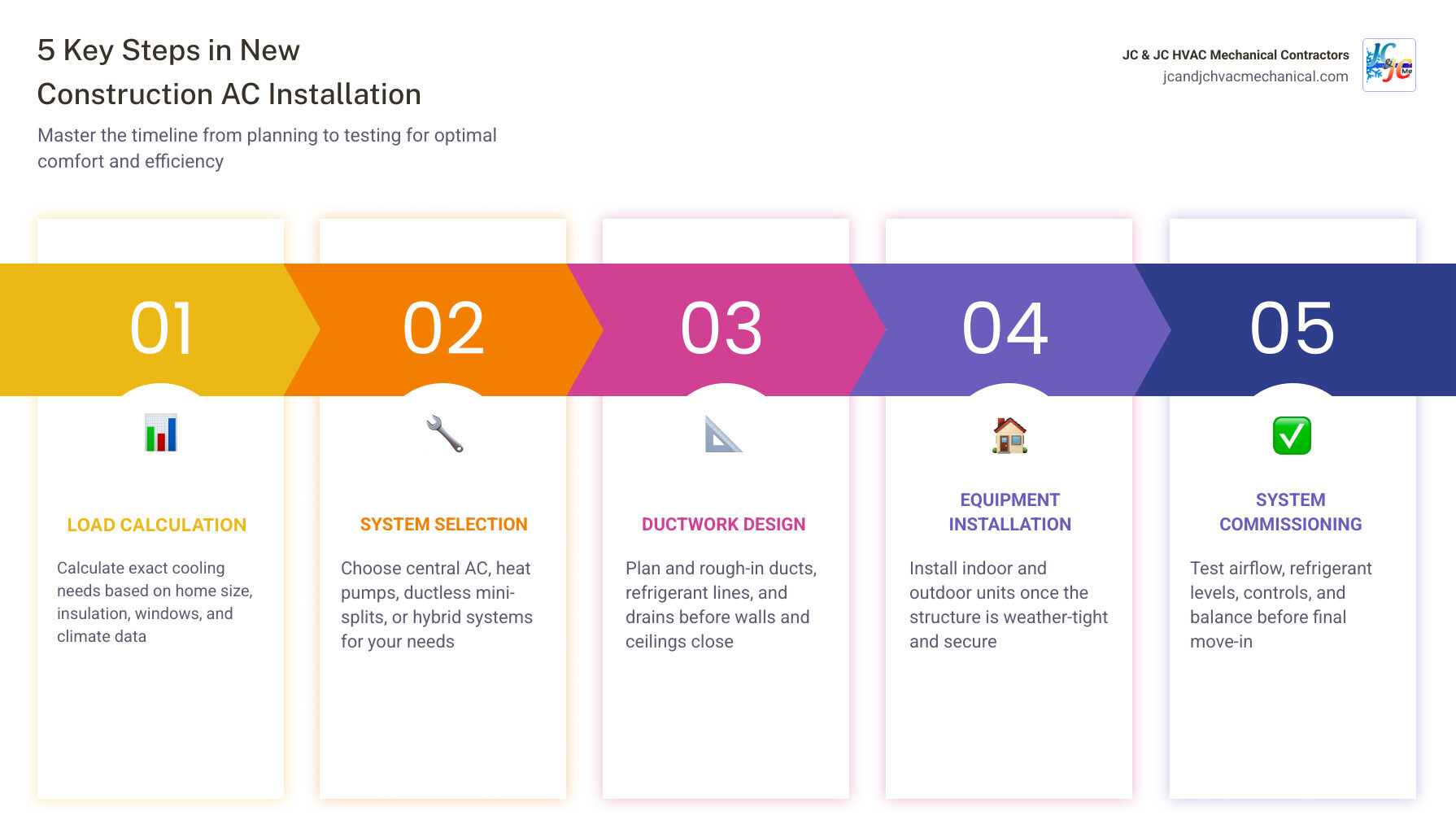
Here’s a quick overview of what new construction AC installation involves:
Key steps in AC installation for new construction homes:
- Load calculation — Determine the correct cooling capacity using your home’s size, insulation, windows, and local climate
- System selection — Choose between central AC, heat pumps, ductless mini-splits, or a hybrid system
- Ductwork design — Plan and rough-in ducts, refrigerant lines, and drains before drywall
- Efficiency compliance — Meet federal SEER2 minimums and local energy codes (IECC, ASHRAE)
- Equipment installation — Set outdoor and indoor units after the structure is weather-tight
- Commissioning — Test airflow, refrigerant charge, controls, and system balance before move-in
In 2024, 98% of new single-family homes were built with central AC — up from 85.5% in 2000. Nearly half of those homes now use a heat pump as the primary heating source. The choices available today are more efficient, more flexible, and more connected than ever. But they also require more careful planning to get right.
For homeowners in the suburban Maryland and DC area, where summers are hot and humid and winters can be genuinely cold, the stakes are high. A system that’s undersized, improperly ducted, or installed without coordination with other trades can cause comfort problems and higher energy bills for years.
This guide walks you through everything you need to know — from system types and sizing to efficiency standards, installation timelines, and how to avoid the most common mistakes.
Understanding AC Installation for New Construction Homes

When we talk about ac installation for new construction homes, we are describing a process that is fundamentally different from a simple retrofit. In an existing home, we are often “handcuffed” by the previous design. We have to work around existing walls, old ductwork that might be too small, and electrical panels that may not be up to the task.
In a new build, we have a clean slate. This allows for a higher level of integration between the HVAC system and the home’s “envelope”—the walls, roof, and windows that keep the outside air out. Modern homes in areas like Bethesda and Silver Spring are built to be incredibly airtight. While this is great for energy bills, it means the AC system must be designed to handle specific ventilation needs that older, “leaky” houses didn’t have to worry about.
The defining characteristic of this work is sequencing. We don’t just show up and drop a unit on a pad. We have to coordinate with framers, plumbers, and electricians. If the ductwork isn’t routed before the plumbing stacks go in, or if the framing doesn’t leave room for a return air plenum, it can lead to costly workarounds later. For a deeper dive into these components, check out our guide on Everything You Need to Know About Your New Home’s Comfort System.
Choosing the Right System Type and Capacity
Selecting the right “engine” for your home’s climate control is the next big step. In our region, we see a variety of popular choices:
- Central Air Conditioning: The traditional choice for 98% of new homes. It uses a central air handler and a network of ducts to distribute air.
- Air-Source Heat Pumps: These are rapidly becoming the standard in Maryland and DC. They provide both cooling and heating by moving heat rather than generating it. In 2024, 47% of new homes used heat pumps.
- Ductless Mini-Splits: Perfect for modern architectural designs with high ceilings or “bonus rooms” where ductwork is difficult to run. They offer incredible efficiency and individual room control.
- Hybrid (Dual-Fuel) Systems: These combine an electric heat pump with a gas furnace. The system automatically switches to gas when temperatures drop significantly, providing the ultimate balance of comfort and efficiency.
One of the most critical parts of the process is the Manual J calculation. This isn’t a “rule of thumb” based on square footage. It is a precise engineering calculation that determines the exact “tonnage” or BTUs required. To learn more about how these numbers are crunched, see How to Choose the Right Size HVAC Unit for Your Home.
Sizing Your AC Installation for New Construction Homes
Getting the size right is a “Goldilocks” situation—it can’t be too big, and it can’t be too small.
If a system is undersized, it will run constantly, struggling to keep up with the humid July afternoons in Washington, D.C. This leads to premature wear and high bills.
However, oversizing is actually the more common mistake in new construction. An oversized unit will “short-cycle,” meaning it turns on, cools the air quickly, and turns off before it has a chance to remove humidity. In our humid climate, this results in a home that feels cold but “clammy,” which can eventually lead to mold issues. We look at window orientation, insulation R-values, and even how many people will live in the home to ensure the capacity is perfect.
Modern Features for AC Installation for New Construction Homes
Since you are building from the ground up, you should consider the latest technology to future-proof your comfort:
- Variable-Speed Technology: Unlike traditional units that are either “on” or “off,” variable-speed compressors can run at lower speeds to maintain a steady temperature, saving massive amounts of energy.
- Multi-Zone Cooling: Why cool the guest bedrooms during the day when everyone is in the kitchen? Zoning allows you to set different temperatures for different areas of the house.
- Smart Thermostats: Integrating these early allows for whole-home automation. You can save up to 20% on heating and cooling costs by using these effectively.
- Advanced Filtration: Modern airtight homes need help with indoor air quality. We can integrate HEPA filtration or UV lights directly into your new ductwork.
If you are wondering about the timeline for these additions, read about When is the Best Time for AC Installation.
Efficiency Standards and Regulatory Requirements
When we perform ac installation for new construction homes in April 2026, we are working under strict federal and local guidelines. The industry has moved toward SEER2 ratings, which are more rigorous than the old SEER standards.
In the Maryland and DC region, the minimum efficiency for central AC is generally 14.3 SEER2. However, many homeowners opt for higher ratings (up to 25 SEER2) to maximize long-term savings. High-efficiency systems also qualify for federal income tax credits—up to $3,200 annually for Energy Star® approved upgrades through 2032.
We also ensure compliance with:
- IECC (International Energy Conservation Code): Governs how well your ducts must be sealed and how much insulation is required.
- ASHRAE 62.2: Sets the standards for mechanical ventilation to ensure you have fresh air in your airtight new home.
| Equipment Category | Federal Minimum Standard (2026) | Recommended for MD/DC |
|---|---|---|
| Central AC | 14.3 SEER2 | 16+ SEER2 |
| Air-Source Heat Pump | 7.5 HSPF2 | 8.5+ HSPF2 |
| Gas Furnace | 80% AFUE | 95%+ AFUE |
For more details on these metrics, check out What is a Good SEER Rating for My New AC.
The Professional Installation Process and Timeline
The timeline for a new build AC project usually spans several months, following the rhythm of the construction:
- Design Phase: We work with your blueprints to perform Manual J (load), Manual S (equipment selection), and Manual D (duct design) calculations.
- Rough-In Phase: This happens after framing but before drywall. We run the ductwork, refrigerant lines, and electrical conduits. This is the most crucial stage for ensuring quiet, efficient airflow.
- Equipment Set: Once the house is weather-tight (windows and doors in) and the “dusty” work like drywall sanding is done, we set the indoor air handler and the outdoor condenser.
- Commissioning: This is the final step. We don’t just “turn it on.” We test the static pressure, check the refrigerant charge, and balance the dampers to ensure every room gets the right amount of air.
Professional AC Installation is vital because manufacturer warranties often require proof of professional setup to remain valid.
Ensuring Quality in AC Installation for New Construction Homes
Quality is found in the details that you can’t see once the walls are closed. We prioritize:
- Duct Sealing: Using Mastic or high-quality sealants to prevent the 20-30% energy loss that is common in poorly installed systems.
- R-Value Insulation: Ensuring ducts in unconditioned spaces (like attics) have at least R-8 insulation.
- Static Pressure Testing: Making sure the “push” of the fan matches the “resistance” of the ducts so the motor doesn’t burn out early.
If you are curious about what happens when these steps are skipped, see 4 Signs It Might Be Time for New Air Conditioner Installation.
Frequently Asked Questions about New Build AC
When should the HVAC system be designed for a new home?
The design should happen as early as possible—ideally during the architectural phase. Waiting until the house is framed can lead to “structural conflicts,” where a massive support beam is exactly where a main trunk line needs to go. Early planning ensures the HVAC system is integrated into the home’s “skeleton” rather than being squeezed into leftover spaces.
What are the benefits of heat pumps in new construction?
Heat pumps are the “Swiss Army Knife” of HVAC. In our region, they offer a massive carbon footprint reduction because they run on electricity, which is increasingly sourced from renewables. They are incredibly efficient in the moderate temperatures of spring and fall, and modern “cold-climate” heat pumps can now handle our freezing winter nights without breaking a sweat.
How does ductwork design impact system performance?
Ductwork is the “circulatory system” of your home. If the ducts are too small, the system will be noisy and the motor will fail early. If they are poorly routed with too many sharp turns, airflow will be weak in the furthest rooms. Strategic vent placement is also key—placing vents near windows helps “wash” the glass with conditioned air to block heat gain or loss.
Conclusion
Building a new home in Washington DC, Silver Spring, or Bethesda is a massive undertaking, but getting the ac installation for new construction homes right from day one ensures that your investment provides comfort for decades. At JC & JC HVAC Mechanical Contractors, we bring expert, professional service backed by over 270 excellent reviews to every job site.
Whether you are building a custom home in Potomac or a modern townhouse in Rockville, our team understands the local climate and the rigorous building codes of Montgomery and Howard Counties. We don’t just install equipment; we design comfort systems that last.
Ready to start planning your new build’s comfort? Contact us for expert AC Installation and let us help you build a home that stays perfectly cool, no matter how high the Maryland humidity climbs.