
What to Expect During AC Replacement: A Quick Overview
What to expect during ac replacement is something every homeowner in the Maryland and Washington, D.C. area should understand before scheduling the job. The good news? For most homes, it’s faster and less disruptive than you might think.
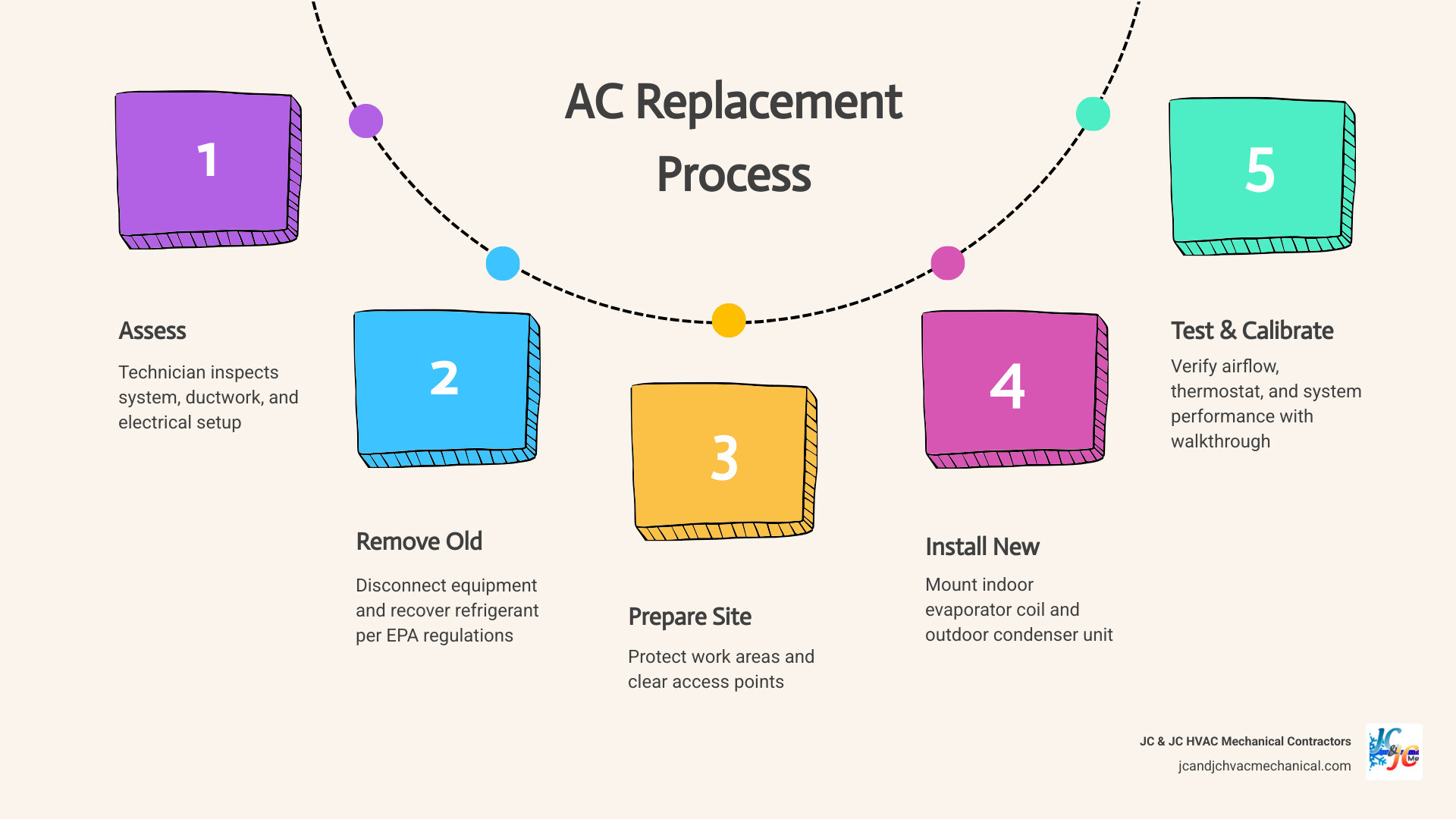
Here’s a quick summary of what typically happens:
- Initial assessment – A technician inspects your existing system, ductwork, and electrical setup
- Old unit removal – The old equipment is safely disconnected and refrigerant is recovered per EPA regulations
- Site preparation – Work areas are protected and access points are cleared
- New equipment installation – Both the indoor evaporator coil and outdoor condenser are installed
- Refrigerant and electrical connections – Lines are vacuumed, charged, and wired to code
- Testing and calibration – Airflow, thermostat accuracy, and system performance are verified
- Final walkthrough – The technician reviews operation, maintenance, and warranty details with you
Typical timeline:
- Standard AC replacement: 4-8 hours (same day)
- Replacement with duct modifications: 1-2 days
- Full HVAC replacement (AC + furnace): 2-3 days
Most homeowners can stay in their home throughout the process. You’ll experience some noise, a few hours without cooling, and technicians moving between your indoor and outdoor equipment areas — but that’s about it.
If your system is over 10-12 years old, running up repair bills, or struggling to keep up during hot summers in the D.C. metro area, a replacement is likely on the horizon. Understanding the process upfront takes the stress out of the decision.
Here in April 2026, modern AC systems are significantly more energy-efficient than units from even a decade ago — using 20-40% less energy than older models. That means a replacement isn’t just about fixing a broken system. It’s an investment in long-term comfort and lower utility bills.
Signs It’s Time for a New System

Knowing when to pull the trigger on a replacement can be tricky. You don’t want to replace a unit that still has good years left, but you also don’t want to wait until it dies on a 95-degree afternoon in Rockville or Bethesda.
The most obvious factor is the system age. Most well-maintained air conditioners last between 15 and 20 years, but they often start showing their age around the 10-to-12-year mark. If your unit was installed back in 2014, it’s likely using outdated technology and may be prone to frequent breakdowns.
We often suggest the “$5,000 Rule” to our neighbors in Montgomery County. Multiply the age of your unit by the cost of a potential repair. If that number is over $5,000, it’s usually smarter to invest in a new installation. For example, a 12-year-old unit needing a $500 repair hits $6,000—a clear sign that your money is better spent on an upgrade. Check out these 4 Signs It Might Be Time for New Air Conditioner Installation for more details on the warning signs.
Another critical factor is energy efficiency. Modern units are rated by SEER (Seasonal Energy Efficiency Ratio). In 2026, the standards have risen significantly. If your current unit has a low SEER rating, you are effectively paying a “tax” every month in the form of higher utility bills. To understand what you should be looking for, read our guide on What Is a Good SEER Rating for My New AC.
Lastly, pay attention to indoor comfort. Are some rooms in your Silver Spring home freezing while others are sweltering? Is the humidity so high that your skin feels sticky even when the AC is running? These are signs of an aging or improperly sized system. If you’re noticing these issues, it might be When Is It Time to Consider a Heating System or AC Installation.
What to Expect During AC Replacement: The Step-by-Step Process
When the big day arrives, the process follows a very specific rhythm. Understanding this sequence helps demystify what to expect during ac replacement.
Step 1: Arrival and Setup
Our team usually arrives in the morning. We’ll start by introducing ourselves and walking through the home to confirm where the indoor and outdoor units are located. We take great care to protect your property, laying down drop cloths and wearing shoe covers to keep your floors clean.
Step 2: Refrigerant Recovery
This is one of the most important technical steps. We don’t just “let out” the old coolant. Per EPA regulations, we must safely recover the refrigerant using specialized machinery. This prevents harmful chemicals from entering the atmosphere.
Step 3: Removing the Old Unit
Once the lines are clear, we disconnect the electrical wiring and the refrigerant lines. The old outdoor condenser and the indoor evaporator coil are then removed. This part of the process usually takes 1 to 2 hours. If you need a more specific look at local services, see our page on AC Installation Replacement Silver Spring MD.
Step 4: Installing the New Equipment
Now the fun begins! We set the new outdoor unit on a level pad and install the new indoor coil. We ensure everything is perfectly aligned and sealed. Proper AC Installation is about more than just “plug and play”—it requires precise mechanical fitting to ensure no air leaks occur.
Preparing Your Home for What to Expect During AC Replacement
You can make the process go much smoother by doing a little prep work before we arrive.
- Clear the Path: Move any patio furniture, potted plants, or toys away from the outdoor unit. Inside, clear a path to your furnace or air handler (usually in the basement, attic, or a utility closet).
- Pet Safety: The sound of power tools and strangers moving in and out can be stressful for pets. It’s best to keep them in a safe, quiet room or at a neighbor’s house for the day.
- Access the Panel: Make sure we have clear access to your electrical breaker panel. We will need to turn off the power to the HVAC system several times during the install.
- Clear the Workspace: If your indoor unit is in a cluttered basement or closet, moving stored items a few feet back gives our technicians the “elbow room” they need to work efficiently. Residents looking for local help can find more tips at AC Installation Replacement Bethesda MD.
Technical Setup and What to Expect During AC Replacement Testing
Once the units are physically in place, we enter the technical phase. This is where the expertise of JC & JC HVAC Mechanical Contractors really shines.
Line Sets and Vacuuming: We install new copper refrigerant lines (or thoroughly clean existing ones if they are compatible). We then use a vacuum pump to remove all air and moisture from the lines. This is critical—if even a tiny amount of moisture remains, it can damage the compressor later on.
Electrical and Thermostat: We wire the system to meet modern safety codes and install your new thermostat. Whether you’re using a standard programmable model or a high-tech smart thermostat, we’ll make sure it’s communicating perfectly with the new unit. For those in the capital, we provide specialized AC Installation Replacement Washington DC.
The “Test Drive”: We don’t just turn it on and leave. We perform a series of tests, including:
- Airflow Testing: Ensuring air is moving at the right velocity through your vents.
- Temperature Split: Checking that the air coming out of the vents is significantly cooler than the air going into the return.
- Refrigerant Charge: Verifying that the pressure levels are exactly where the manufacturer specifies.
Factors That Influence the Installation Timeline
While we aim for a single-day turnaround, certain factors can extend the job.
| Type of Installation | Estimated Time |
|---|---|
| Standard AC Change-Out | 4 – 8 Hours |
| AC + Minor Duct Repair | 1 Day |
| Full HVAC (AC + Furnace) | 2 – 3 Days |
| Complex/Multi-Zone System | 2 – 4 Days |
Ductwork Condition: If your ducts are leaky, undersized, or disconnected, we’ll need to address that. There’s no point in installing a high-efficiency AC if the cold air is escaping into your attic! It’s often best to Stop Patching the Leaks and Know When to Replace Your HVAC ductwork at the same time.
Electrical Upgrades: Older homes in areas like Germantown or Potomac may have electrical panels that aren’t rated for modern high-capacity systems. If we need to upgrade your circuit breakers or wiring, it adds a few hours to the timeline.
Equipment Location: A unit in a wide-open basement is a quick job. A unit tucked into a tight crawl space or a 130-degree attic requires more time and care for the safety of our crew. To avoid the busiest (and hottest) times of year, we recommend you Beat the Summer Rush Replace Your HVAC System Before the Heat Sets In.
Choosing the Right System for Your Home
Selecting the right unit is a science. You can’t just pick the biggest one and assume it will be “better.” An oversized unit will “short-cycle,” turning on and off too frequently, which wears out the motor and fails to remove humidity.
We use Tonnage Calculations based on your home’s square footage, insulation quality, and window orientation.
- 1.5 Tons: 600 – 1,100 sq ft
- 2.5 Tons: 1,201 – 1,650 sq ft
- 3.5 Tons: 1,801 – 2,300 sq ft
- 5.0 Tons: 2,401 – 3,300 sq ft
You also have choices in technology. You might be deciding between a traditional central air system or a ductless mini-split for a new addition or a home without existing ducts. If you’re stuck, our guide on How to Decide Between Central Air and Mini-Split Installation can help.
When considering the timing of your purchase, keep in mind that When Is the Best Time for AC Installation is usually in the shoulder seasons (spring and fall) when demand is lower. This is also a great time to evaluate The Real Cost of Repairing vs Replacing Your HVAC System so you aren’t making a rushed decision in the middle of a heatwave.
Frequently Asked Questions about AC Replacement
How long will I be without cooling during the process?
For a standard replacement, your cooling will be offline for about 4 to 8 hours. We recommend closing your blinds and curtains in the morning to trap the cool air inside. Using ceiling fans can also help keep the air moving while the system is down. Most homes in the Maryland area only see a temperature rise of a few degrees during the window we are working.
Do I need to leave my house during the installation?
Nope! You are more than welcome to stay. In fact, most of our customers in Beltsville and Laurel go about their normal day—working from home, watching TV, or doing chores. Just be aware that there will be some noise (drilling, vacuum pumps, and occasional hammering) and technicians will be moving between the indoor and outdoor areas. We do ask that you stay clear of the immediate work zone for your safety.
Should I replace my furnace at the same time as the AC?
This is a very common question. If your furnace is also over 12-15 years old, it often makes sense to do a full HVAC replacement. Since the indoor AC coil sits right on top of (or inside) your furnace, replacing them together saves on labor. Plus, modern AC units are designed to work in “matched pairs” with specific furnace blowers to achieve those high SEER ratings. It’s often better to Stop Patching the Leaks and Know When to Replace Your HVAC as a complete system to ensure maximum efficiency and a single warranty for the whole setup.
Conclusion
At JC & JC HVAC Mechanical Contractors, we pride ourselves on making the AC replacement process as smooth as possible for our neighbors across Washington, D.C., Montgomery County, and Howard County. Once the installation is complete, we don’t just pack up and leave. We’ll take you on a final walkthrough, showing you how to operate your new thermostat and how to change your filters.
We’ll also review your maintenance plan and warranty details. A new AC is a big investment, and we want to help you protect it for the next 20 years. From Rockville to Silver Spring, our expert team is here to ensure you stay cool without the stress.
Ready to upgrade your home comfort? Whether you need a simple swap or a complex system redesign, we’re ready to help. Explore our AC Installation services today and get ready to enjoy a cooler, more efficient summer!