
Getting the AC Size Right Before the First Nail Goes In
How to choose the right AC size for a new build is one of the most important decisions you’ll make during the entire construction process — and it’s one that most homeowners don’t think about until it’s too late.
Here’s a quick answer to get you started:
To choose the right AC size for a new build:
- Get a Manual J load calculation performed by a licensed HVAC contractor — this is the industry standard method
- Account for your home’s specific features: insulation type, window orientation, ceiling height, square footage, and local climate
- Don’t rely on square footage alone — two homes the same size can need systems that differ by a full ton
- Match your ductwork to the unit using Manual D calculations to avoid airflow problems
- Choose the right tonnage — residential systems typically range from 1.5 to 5 tons (18,000 to 60,000 BTUs per hour)
- Work with your builder and HVAC contractor together during the design phase, not after framing is done
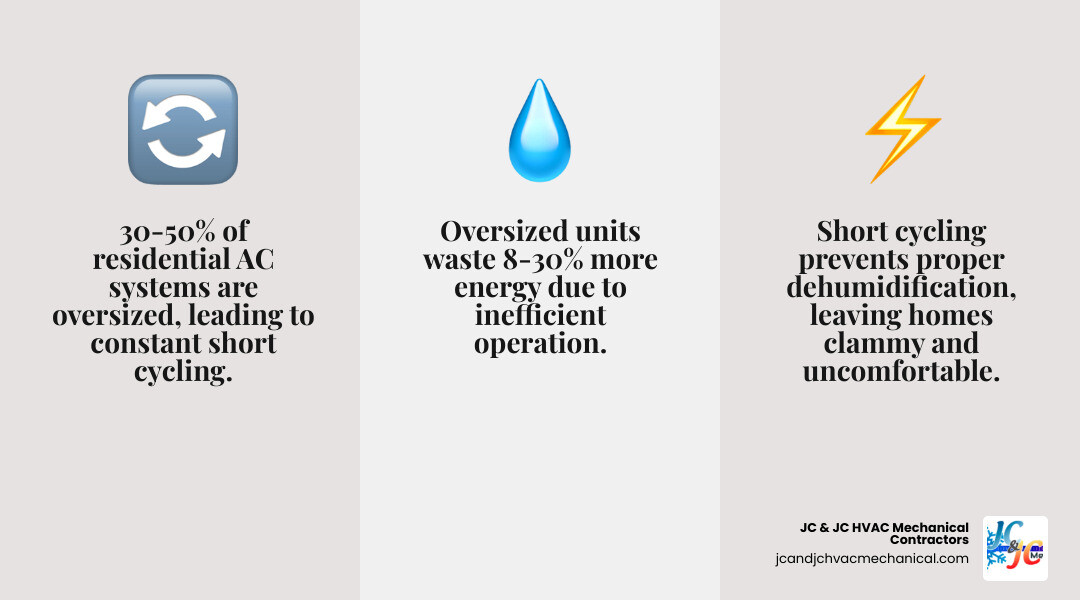
Here’s the uncomfortable truth: studies show that between 30 and 50% of residential AC systems are improperly sized — and the vast majority of those are too big, not too small. An oversized unit short-cycles, meaning it blasts cold air, shuts off quickly, and never runs long enough to pull humidity out of the air. That leaves your brand-new home feeling clammy, uncomfortable, and expensive to run — even with a top-of-the-line system.
New construction is actually your best opportunity to get this right. You have the blueprints in hand, the walls aren’t closed yet, and every decision — insulation, windows, ductwork routing — is still on the table. But that window closes fast.
Why Proper AC Sizing is Critical for New Construction
When we talk about AC “size,” we aren’t talking about the physical dimensions of the outdoor box. We are talking about cooling capacity, measured in BTUs (British Thermal Units) or tons. One ton of cooling equals 12,000 BTUs per hour. For a new build in the Washington, D.C. or Maryland area, getting this number right is the difference between a sanctuary and a swamp.
Proper sizing is critical because modern homes are built differently than those from twenty years ago. We use better seals, advanced house wraps, and superior insulation. If you use an old “rule of thumb” to size a 2026 home, you will almost certainly end up with an oversized unit.
The consequences of oversizing are severe. First, there is short cycling. This happens when a powerful unit cools the air so fast that the thermostat reaches its target in five or ten minutes and shuts the system down. Because the system isn’t running long enough, it fails at its second job: dehumidification. In our humid Mid-Atlantic summers, you’ll end up with a house that is 72 degrees but feels damp and “sticky,” which is a recipe for mold growth.
Furthermore, short cycling is brutal on equipment. Constant starting and stopping wears out the compressor 50% faster than normal operation. From an efficiency standpoint, an oversized AC can increase energy consumption by 8 to 30%. When you understand everything you need to know about your new home’s comfort system, you realize that “bigger” is rarely “better.”
How to choose the right ac size for a new build using Manual J
If square footage rules are out, what’s in? The gold standard is the Manual J load calculation. Developed by the Air Conditioning Contractors of America (ACCA), this is a scientific method that looks at the “load” of the house—essentially, how much heat the house gains from the outside.
Fewer than 20% of HVAC contractors actually take the time to perform a proper Manual J calculation, often relying on “guestimates” instead. However, for a new build, this is non-negotiable. A Manual J calculation considers:
- The exact R-value of your wall and attic insulation.
- The “U-value” and solar heat gain coefficient of your windows.
- The direction the house faces (orientation).
- Local climate data for Bethesda, Rockville, or Silver Spring.
- The number of occupants and even the heat generated by your appliances.
By using this data, we can determine the exact cooling needs of each room. This ensures you aren’t paying for more capacity than you need. To learn more about the technical side of this process, check out our guide on how to choose the right size HVAC unit for your home.
The role of climate and ductwork in how to choose the right ac size for a new build
Our local climate in the Mid-Atlantic zone presents a unique challenge: we have hot, “soupy” summers and freezing winters. This means your AC needs to be a workhorse in July, but your ductwork has to handle the airflow for both cooling and heating efficiently.
Ductwork is often the “forgotten” half of the HVAC system. Even the perfectly sized 3-ton unit will fail if the ducts are too small to move that air. This is why we use Manual D to design the duct system alongside the unit sizing. In a new build, we have the luxury of designing straight, sealed, and properly sized runs.
Did you know that unsealed or poorly designed ducts can waste 20 to 30% of your energy? In a new construction project, we ensure every joint is mastic-sealed. This prevents air from escaping into the attic or crawlspace before it ever reaches your living room. For expert assistance with these layouts, our air conditioning services/AC installation team specializes in integrating high-performance ductwork into new architectural designs.
Key Factors Influencing Your New Build’s Cooling Load

Every choice you make with your builder changes the “math” of your AC size. For example, if you opt for spray foam insulation instead of traditional fiberglass batts, your home becomes significantly more airtight. This reduces the “infiltration” of outside air, meaning you might actually need a smaller (and less expensive) AC unit than the blueprints originally suggested.
Window orientation is another massive factor. A wall of floor-to-ceiling windows facing west will act like a giant magnifying glass in the afternoon. Without proper planning, that single room could be 10 degrees hotter than the rest of the house. We also have to account for ceiling height. Vaulted 12-foot ceilings create a larger volume of air that needs to be cooled compared to standard 8-foot ceilings, often increasing requirements by 5% for every extra foot of height.
Tonnage Impact Comparison Table
The following table illustrates how high-efficiency features can drastically change the required tonnage for a typical 2,500 sq. ft. home in our region.
| Feature | Standard Build Impact | High-Efficiency Build Impact |
|---|---|---|
| Insulation | R-13 Walls / R-30 Attic | R-21+ Walls / R-49+ Attic (Load ↓ 15%) |
| Windows | Double Pane Standard | Low-E / Argon Filled (Load ↓ 10-15%) |
| Air Sealing | Standard Caulk/Seal | Spray Foam / AeroBarrier (Load ↓ 20%) |
| Lighting | Mixed Incandescent/LED | 100% LED (Lower Internal Heat) |
| Result | May require 4.0 Tons | May require 3.0 Tons |
Avoiding common mistakes in how to choose the right ac size for a new build
The biggest mistake we see in new builds is “sizing for the future” by adding an extra half-ton “just in case.” Homeowners often think they are buying insurance against a heatwave, but they are actually buying a ticket to high energy bills and a shorter equipment lifespan.
Another common error is ignoring the SEER2 rating. SEER2 (Seasonal Energy Efficiency Ratio) is like the MPG for your air conditioner. While a higher SEER2 doesn’t change the size you need, it does change how much it costs to run that size. You can find out more about what makes a rating “good” in our article what is a good SEER rating for my new AC.
Lastly, always ensure you have AHRI certified matches. This means the indoor coil and the outdoor condenser are tested to work together. If your builder mixes and matches brands or older components with new ones, you won’t get the efficiency or the capacity you’re paying for.
Strategic Planning: Collaboration and Advanced Systems
The best time to finalize your AC plan isn’t when the drywall is going up—it’s during the design phase. When architects, builders, and HVAC contractors collaborate early, we can find “hidden” spaces for ductwork that don’t require ugly soffits or dropped ceilings. This coordination is part of knowing when is the best time for AC installation to maximize both aesthetics and performance.
For modern new builds, we often recommend multi-stage or variable-speed systems.
- Single-stage: Like a light switch—it’s either 100% on or 100% off.
- Variable-speed: Like a dimmer switch—it can run at 30% capacity on a mild day and 100% only when it’s truly scorching.
These advanced systems are much more forgiving if a calculation is slightly off, as they can throttle down to maintain a steady, whisper-quiet flow of air. When paired with zoning—which allows you to set different temperatures for the upstairs bedrooms and the downstairs kitchen—you get the ultimate in custom comfort. This setup typically requires about 400 CFM (Cubic Feet per Minute) of airflow per ton of cooling to function correctly.
Frequently Asked Questions about New Build AC Sizing
Should I oversize my AC for extreme heat waves?
Absolutely not. HVAC systems are designed based on “design conditions”—the temperature that is exceeded only about 1% of the hours in a year. In the D.C. area, that’s usually around 94-95 degrees. Manual S (the standard for equipment selection) allows for a maximum of 15% oversizing for cooling. If you go beyond that, you lose the ability to dehumidify on the “normal” 85-degree days that make up most of our summer. A properly sized unit should run almost continuously on the hottest day of the year; that’s exactly what it’s built to do!
How do high-efficiency features reduce required tonnage?
Think of your home like a thermos. If the thermos is high-quality and the lid is tight, the ice inside stays frozen with very little effort. High-efficiency features like spray foam and Energy Star windows create a tighter “thermal envelope.” This means heat stays out in the summer and in during the winter. Because the house gains heat much more slowly, the AC doesn’t have to work as hard (or be as large) to keep things cool.
What should I ask my builder about the HVAC plan?
Don’t be afraid to get specific. Ask these three questions:
- “Can I see the Manual J load calculation report for this specific floor plan and orientation?”
- “Are the ducts being sealed with mastic and tested for leakage before the drywall goes up?”
- “Is the indoor coil an AHRI-certified match for the outdoor unit?” A quality builder will be happy to provide these details because they ensure the long-term value of the home.
Conclusion
Choosing the right AC size for your new build isn’t a task for a “rule of thumb” or a quick guess. It’s a scientific process that, when done correctly, ensures your new home in Washington D.C., Montgomery County, or Howard County is a haven of comfort for decades to come.
At JC & JC HVAC Mechanical Contractors, we pride ourselves on expert, professional service backed by over 270 excellent reviews. We don’t just “install boxes”—we engineer comfort systems tailored to the unique architecture of your new build. From Beltsville to Germantown, and Rockville to Laurel, we are here to ensure your system is perfectly sized—neither too big for its britches nor too small for the job.
Ready to ensure your new build is as comfortable as it is beautiful? Contact us today for a professional assessment and a precision air conditioning services/AC installation plan.